
Plantar fascia
Measure the plantar fascia for thickening behind heel pain.

A private ultrasound of your heel, sole and forefoot — for plantar fasciitis, pain in the ball of the foot, Morton's neuroma, lumps or tendon problems.
From heel to toes.Choose your clinic and view appointment options in our online booking system.
Explore your appointmentHear from people
who have visited us.

Foot pain often comes from the plantar fascia, small nerves or tendons. Ultrasound shows these soft tissues clearly and can pinpoint the tender spot.
Measure the plantar fascia for thickening behind heel pain.
Look between the toes for a thickened nerve causing burning or numbness.
Check the foot tendons and bursae for inflammation and tears.
Identify ganglions, plantar fibromas and other soft-tissue lumps.
A Foot Ultrasound Scan is a non-invasive diagnostic procedure that provides detailed images of the soft tissues, tendons, ligaments, and joints in the foot. It is highly effective in diagnosing conditions such as plantar fasciitis, tendonitis, ligament injuries, and arthritis. This dynamic imaging method helps healthcare providers assess and diagnose foot-related issues with precision, offering real-time insights into movement and function.
Hear the summary of the text below from the following voice:
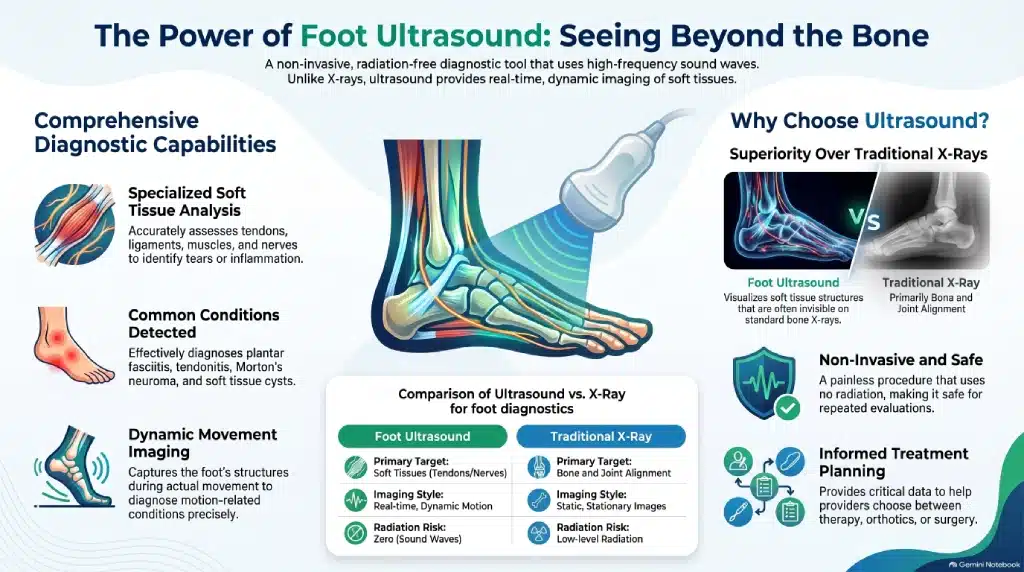
A Foot Ultrasound uses high-frequency sound waves to produce real-time images of the structures within the foot. It is particularly useful for examining:
This scan is ideal for diagnosing soft tissue injuries or conditions that affect mobility, providing a comprehensive view of the internal structures of the foot.
A Foot Ultrasound is vital for diagnosing various foot conditions by:
This scan is recommended for individuals experiencing:
If you’re experiencing foot pain, discomfort, or mobility issues, a Foot Ultrasound Scan can provide critical insights to accurately diagnose your condition. Schedule your scan today for a comprehensive evaluation and take the first step toward relief and recovery.
From getting ready to discussing what comes next, here is a simple guide to your appointment.
A question before you book? Call usAn injury, a gradual ache, swelling, clicking or weakness — and which activities bring it on. Point to exactly where it hurts.
You lie or sit with your foot supported. Gel is applied and the probe is moved over the heel, sole and forefoot. It is painless and takes about 20 minutes for one side.
The sonographer explains what they have seen, and your written report follows within 24 hours — ready to share with your GP, physiotherapist or orthopaedic specialist.
Choose the location that works for you. Confirm your selected clinic in the booking system before completing your appointment.
Need something more personal?
Speak to the team before booking.
No. You can book directly. A referral letter from your GP, physiotherapist or consultant is welcome but not required.
Book one side if only one foot is affected. Choose Two Sides if both are painful, or if your clinician wants a comparison. Combined options are in the booking form.
Yes. It shows thickening of the plantar fascia and helps rule out other causes of heel pain.
Yes. Choose Foot & Ankle in the booking form to have both checked in one appointment.
If you cannot bear weight or move the joint, have a visible deformity, numbness, or think something may be broken, go to an urgent treatment centre or A&E rather than waiting for a scan.
Use the booking form on this page and follow its Next buttons. Choose one side, two sides or a combined option and your appointment time, enter the requested details, then review the price before completing the booking.
Book your foot ultrasound below. Follow the booking form’s Next buttons to continue, one step at a time.
Loading the booking form…
Calendar not displaying? You can open the booking page in a new tab ↗.
Call the teamBooking more than one area, or both sides? Choose the matching option in the booking form. If anything is unclear, call us on 020 3318 1373 before your visit.
If you feel unwell, seek medical advice. This page is general information, not a diagnosis. For urgent concerns, contact your GP or NHS 111; in an emergency call 999.
Further reading: NHS guidance on plantar fasciitis · NHS guidance on Morton's neuroma
The primary purpose of a foot ultrasound scan is to assess key structures within the foot joint, including: -Tendons -Tendon sheaths -Bursa -Ligaments
Common reasons for undergoing a foot ultrasound scan include: - Pain assessment: Identifying sources of pain in the foot or ankle. - Reduced movement: Evaluating limitations in foot movement. - Detection of tears: Assessing tears in tendons or ligaments. - Discomfort and inflammation: Diagnosing causes of discomfort and inflammation. - Specific conditions: Identifying conditions like plantar fasciitis, plantar fibroma, Morton's neuroma. - Soft tissue masses: Detecting masses such as ganglia or lipomas. - Joint and tendon pathologies: Evaluating bursitis, capsulitis, tendonitis, and tendon tears. - Other issues: Diagnosing heel spurs, tarsal tunnel syndrome, muscular damage, joint effusions, vascular problems, hematomas, and post-surgical complications. - Bone pathology: Some bone-related conditions like arthritis can also be assessed.
Please select Appointment type and Branch location to see time slots for booking- alternatively, please contact us via the chat, call or email, 020-3318-1373
If you’re experiencing foot pain, swelling, or lumps, a foot ultrasound can be an effective, non-invasive diagnostic tool. Also known as an ultrasound foot scan, this imaging technique helps visualize the soft tissues, tendons, ligaments, and joints of your foot and ankle to detect various conditions.
An ultrasound of foot uses high-frequency sound waves to create real-time images of the structures inside your foot and ankle. It is painless, safe, and often performed in outpatient clinics or private scan centers. You might hear it referred to as an ultrasound scan on foot, ultrasound on feet, or foot scan.
The sonographer applies a water-based gel to your foot and moves a small probe over the skin, capturing detailed images. The procedure is quick and painless. It can also be used for specific areas such as an ultrasound scan on toe or an ankle and foot scan.
If you’re searching for a private foot ultrasound near me or ultrasound scan on toe in London, many clinics provide fast access to high-quality scans. Whether you need a foot scan NHS appointment or prefer a private clinic, it’s important to choose experienced professionals.
A child foot ultrasound scan is also available for young patients to evaluate developmental issues or injury-related problems without exposure to radiation.
While an MRI offers detailed bone and soft tissue imaging, a foot ultrasound is often preferred for dynamic assessment and guiding treatments like injections or ultrasound foot therapy.
Don’t ignore persistent foot pain or lumps. A detailed ultrasound foot scan can provide crucial insights and help your doctor plan the best treatment. Contact us for a private ultrasound scan or ultrasound scan London appointment.
Please check what preparation is needed before your ultrasound scan below:
| All Pelvic scans Kidney and Urinary tract Prostate & Urinary Tract Appendicitis Early Pregnancy Scan | Drink One Liter of still water (2 Pints) One hour before your scan. Do NOT use the toilet so you would arrive with a full bladder. Medication can be taken as normal. |
| Liver scans Upper Abdomen Liver Fibroscan (Liver Elastography) | Do NOT eat for 6 hours prior to scan time. |
| Combination of above scans | Same as respective scan’s preparation. |


