Bladder scanning is a non-invasive and painless procedure that uses a handheld ultrasound device called a bladder scanner to assess the amount of urine present in the bladder. The scanner emits harmless sound waves that bounce off the bladder and create images or measurements of its volume, providing valuable information about urinary retention, residual urine, or bladder capacity. By accurately assessing bladder volume, bladder scanning helps minimize the need for catheterization, reduces the risk of urinary tract infections, and ensures patient comfort and dignity. In this blog post, we will explore what bladder scanning entails and discuss the benefits it offers for patients and healthcare providers.
| Topic | Description |
|---|---|
| Definition of bladder scanning | A non-invasive and painless procedure that uses a handheld ultrasound device called a bladder scanner to assess the amount of urine in the bladder. |
| How it works | The scanner emits harmless sound waves that bounce off the bladder and create images or measurements of its volume. |
| What measurements show | Provides information about urinary retention, residual urine, or bladder capacity. |
| Procedure steps | Patient preparation, positioning, gel application, scanning process, and result interpretation. |
| Non-invasive benefit | Does not involve catheter insertion and eliminates discomfort associated with catheterization. |
| Accurate volume assessment | Provides accurate measurements to assess urinary retention and effectiveness of bladder emptying. |
| Reduces catheterization | Helps minimize unnecessary catheter use and reduces the risk of urinary tract infections (UTIs). |
| Time and cost savings | Quick bedside procedure that eliminates the need for time-consuming catheterization and equipment. |
| Patient comfort and dignity | Preserves comfort and dignity by avoiding invasive catheter procedures. |
What is Bladder Scanning?
Bladder scanning involves the use of a handheld ultrasound device called a bladder scanner to assess the amount of urine present in the bladder. The scanner emits harmless sound waves that bounce off the bladder and create images or measurements of the bladder’s volume. These measurements provide valuable information about urinary retention, residual urine, or bladder capacity.
Procedure for Bladder Scanning
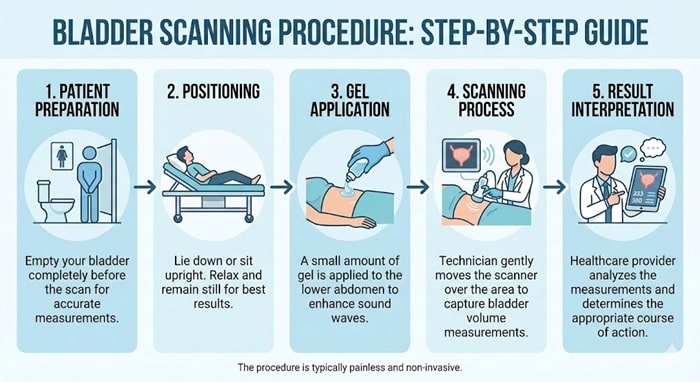
The procedure for bladder scanning is straightforward and typically painless. Here’s what you can expect:
Patient Preparation
Before the scan, you may be asked to empty your bladder completely. This ensures accurate measurements of residual urine.
Positioning
You will be positioned comfortably, either lying down or sitting upright. It’s important to relax and remain still during the scan to obtain accurate results.
Gel Application
A small amount of gel is applied to the lower abdomen or pelvic area. The gel enhances sound wave transmission and helps the scanner obtain clear images.
Scanning Process
The healthcare provider or trained technician will gently move the bladder scanner over the lower abdomen or pelvic area. The device will emit sound waves and capture images or measurements of the bladder’s volume.
Result Interpretation
The measurements obtained from the bladder scan will be analyzed by the healthcare provider. They will interpret the results and determine the appropriate course of action based on the findings.
Benefits of Bladder Scanning
Bladder scanning offers several benefits for both patients and healthcare providers. Let’s explore them:
Non-Invasive and Painless
Bladder scanning is a non-invasive procedure that does not involve the insertion of a catheter into the bladder. It eliminates the discomfort associated with catheterization, making it a more comfortable option for patients.
Accurate Volume Assessment
Bladder scanning provides accurate measurements of the bladder’s volume, allowing healthcare providers to assess urinary retention or determine the effectiveness of bladder emptying. It helps identify individuals at risk of urinary complications and guides appropriate interventions.
Minimizes the Need for Catheterization
By accurately assessing bladder volume, bladder scanning can help reduce unnecessary catheterizations. This is especially beneficial in minimizing the risk of urinary tract infections (UTIs) and associated complications.
Time and Cost Savings
Bladder scanning is a quick procedure that can be performed at the bedside. It eliminates the need for time-consuming catheterizations and associated equipment, resulting in cost savings for healthcare facilities and reduced waiting times for patients.
Patient Comfort and Dignity
Bladder scanning respects patient comfort and preserves their dignity by offering a non-invasive alternative to catheterization. It minimizes the discomfort, embarrassment, and potential complications associated with catheter use.

Conclusion
Bladder scanning is a valuable non-invasive procedure that provides accurate measurements of the bladder’s volume. It offers numerous benefits, including patient comfort, accurate volume assessment, reduced need for catheterization, time and cost savings, and minimized risk of complications. By incorporating bladder scanning into clinical practice, healthcare providers can optimize patient care, improve patient experience, and make informed decisions regarding urinary management.
Frequently Asked Questions
What is bladder scanning?
Bladder scanning is a non-invasive and painless procedure that uses a handheld ultrasound device to assess the amount of urine in the bladder by creating images or measurements of its volume.
What information does a bladder scan provide?
It provides valuable information about urinary retention, residual urine, and bladder capacity.
What device is used during bladder scanning?
A handheld ultrasound device called a bladder scanner is used to emit sound waves and measure bladder volume.
How should a patient prepare before a bladder scan?
The patient may be asked to empty their bladder completely to ensure accurate residual urine measurements.
What is the typical positioning during the procedure?
The patient may lie down or sit upright, and should remain still and relaxed to ensure accurate results.
Why is gel applied to the lower abdomen?
A small amount of gel is applied to enhance sound wave transmission and help obtain clear images.
What happens during the scanning process?
A healthcare provider gently moves the bladder scanner over the lower abdomen or pelvic area to capture images or measurements of bladder volume.
How are the results used?
A healthcare provider analyzes the measurements and determines the appropriate course of action based on the findings.
This sounds much more comfortable than traditional methods, which is reassuring 👍 But I still worry about borderline cases 😕 If the scan shows partial retention, how do doctors decide whether to intervene or wait? That uncertainty can be stressful for patients.
I didn’t realize the handheld scanner gives instant results—it’s kinda neat. Quick question, though: do you need a full bladder for it to work, or can it measure even if you’ve just gone to the toilet? I like that it avoids catheters and lowers UTI risks. Seems like a simple procedure, and I like that it respects patient dignity. Wish more hospitals used this instead of defaulting to catheterization—it seems like a no-brainer.
I had no idea bladder scans could be done so quickly and without a catheter—sounds way more comfortable. does it really work if someone can’t sit still or moves a bit during the scan? Also, I liked that it saves time for both patients and staff. I’ve had a few friends talk about catheter issues before, and this seems like such a simple alternative. Definitely makes me less nervous if I ever need one.
I appreciate how much emphasis was placed on patient comfort and dignity. That’s really important in healthcare.