Your kidneys are vital organs that work quietly behind the scenes, keeping your body functioning at its best. They filter waste, balance fluids, produce essential hormones, and regulate blood pressure—jobs that are absolutely crucial for your overall well-being. Despite their importance, kidney issues can develop without showing any warning signs, making early detection a lifesaver. A kidney ultrasound is a simple, non-invasive test that can uncover problems before they turn into serious health challenges. Let’s dive into why this scan is so important, the symptoms to watch out for, and the common kidney issues it can help diagnose.
| Aspect | Key Information |
|---|---|
| What a Kidney Ultrasound Is | A painless, radiation-free imaging test using sound waves to create detailed images of the kidneys. |
| Main Purpose | Helps detect structural abnormalities, identify conditions, and monitor existing kidney problems. |
| Why It Matters | Allows early detection of silent kidney diseases before serious damage occurs. |
| Key Warning Symptoms | Flank or back pain, painful or frequent urination, blood in urine, swelling, high blood pressure, fatigue, nausea. |
| Common Conditions Detected | Kidney stones, infections, chronic kidney disease, polycystic kidney disease, tumors or cysts, hydronephrosis, congenital abnormalities. |
| Preparation | Drinking water beforehand may be required to keep the bladder full for clearer imaging. |
| How the Scan Is Done | Gel is applied to the abdomen and a transducer is used to create kidney images. |
| Procedure Duration | The scan usually takes 20–30 minutes. |
| Safety & Comfort | Non-invasive, painless, and completely radiation-free. |
| Main Benefits | Early detection, detailed assessment of kidney size and shape, and peace of mind. |
What is a Kidney Ultrasound?
A kidney ultrasound is a painless, radiation-free imaging test that uses sound waves to create detailed pictures of your kidneys and surrounding areas. It’s quick, completely safe, and doesn’t require any recovery time. This test helps doctors identify structural abnormalities, detect underlying conditions, and monitor existing kidney issues. According to my.clevelandclinic.org:
Your healthcare provider recommends a kidney ultrasound when they need more information about what could be causing a kidney problem. A kidney ultrasound typically includes images of your bladder, too.
A kidney ultrasound is commonly used to check for kidney stones, infections, and blockages that affect normal urine flow. It can also help identify kidney cysts or tumors, detect urine build-up (hydronephrosis), and assess changes in kidney size or shape linked to chronic kidney disease or injury.
Think of it as a window into your kidney health, giving you the information you need to take control of your well-being.
Why Kidney Ultrasounds Matter
Kidney problems often progress silently. Many conditions don’t show symptoms until significant damage has occurred, which is why early detection is so vital. Whether you’re managing a chronic condition, experiencing unusual symptoms, or seeking peace of mind through preventive care, a kidney ultrasound is an invaluable tool.
This simple test can catch problems early, allowing for timely treatment that may prevent complications like kidney failure, infections, or hypertension.

Symptoms That Might Signal Kidney Issues
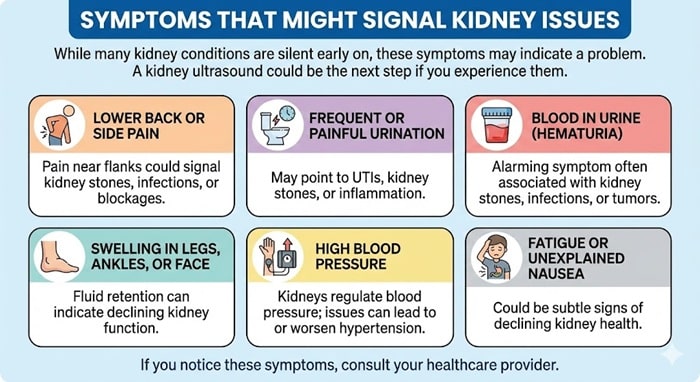
While many kidney conditions remain silent in the early stages, certain symptoms can indicate a problem. If you’re experiencing any of the following, a kidney ultrasound might be your next best step:
- Lower Back or Side Pain: Pain near your flanks could signal kidney stones, infections, or blockages.
- Frequent or Painful Urination: This may point to urinary tract infections (UTIs), kidney stones, or inflammation.
- Blood in Urine (Hematuria): An alarming symptom often associated with kidney stones, infections, or tumors.
- Swelling in the Legs, Ankles, or Face: Fluid retention can indicate declining kidney function.
- High Blood Pressure: Kidneys play a key role in blood pressure regulation, so issues can lead to or worsen hypertension.
- Fatigue or Unexplained Nausea: These could be subtle signs of declining kidney health.
Common Kidney Issues Detected by Ultrasound
Kidney ultrasounds can identify a wide range of conditions, from common issues to more serious concerns:
1. Kidney Stones
Kidney stones are hard deposits of minerals and salts that form in your kidneys. They can be tiny or grow large enough to cause excruciating pain. A kidney ultrasound can detect these stones before they cause severe discomfort or complications, enabling prompt treatment to prevent blockages or infections.
2. Kidney Infections (Pyelonephritis)
Chronic or severe UTIs can spread to your kidneys, leading to inflammation or abscesses. A kidney ultrasound can reveal swelling or structural changes caused by infections, allowing for accurate diagnosis and treatment.
3. Chronic Kidney Disease (CKD)
CKD develops when kidney function gradually declines over time. Ultrasounds can identify signs like kidney shrinkage or scarring, giving doctors the information needed to manage the condition and prevent further damage.
4. Polycystic Kidney Disease (PKD)
This inherited condition causes cysts to grow on your kidneys, which can impair their function. Ultrasounds are a reliable way to diagnose PKD early, especially if you have a family history of the disease.
5. Kidney Tumors or Cysts
Not all growths on your kidneys are cancerous, but detecting them early is crucial. A kidney ultrasound can differentiate between benign cysts and malignant tumors, ensuring you get the appropriate care.
6. Hydronephrosis
This condition involves the swelling of a kidney due to urine build-up, often caused by a blockage or obstruction. A kidney ultrasound can pinpoint the cause, which may appear as a dark spot on the kidney ultrasound, helping doctors restore proper kidney function.
7. Congenital Abnormalities
Structural issues present from birth can sometimes go undiagnosed until later in life. Kidney ultrasounds can detect these abnormalities, enabling proactive management.
How is a Kidney Ultrasound Performed?
A kidney ultrasound is a simple, stress-free process:
- Preparation: In most cases, you may be asked to drink water beforehand to ensure your bladder is full. This helps improve the clarity of the images.
- The Scan: You’ll lie on a comfortable table while a gel is applied to your abdomen. A technician will use a handheld device called a transducer, which sends sound waves into your body to create images of your kidneys.
- Time: The procedure typically lasts 20-30 minutes.
- Results: Your doctor will review the images and discuss the findings, usually within a few days.
Benefits of Kidney Ultrasounds
- Non-Invasive and Painless: No needles, no incisions—just a quick and easy scan.
- Radiation-Free: Unlike some imaging tests, ultrasounds are completely safe.
- Early Detection: Identifies issues before they cause symptoms, giving you a head start on treatment.
- Comprehensive Insights: Provides detailed images of kidney size, shape, and function.

Take Control of Your Kidney Health
Your kidneys work tirelessly to keep you healthy. Don’t wait for symptoms to appear before you take action. Whether you’re managing an existing condition, experiencing troubling signs, or simply being proactive, a kidney ultrasound is a step toward protecting your health.
Ready to prioritize your kidney health? Book your kidney ultrasound in London today and gain the peace of mind you deserve.
Frequently Asked Questions
What is a kidney ultrasound?
A kidney ultrasound is a painless, radiation-free imaging test that uses sound waves to create detailed pictures of the kidneys and surrounding areas. It helps identify structural abnormalities, detect underlying conditions, and monitor existing kidney issues.
Why are kidney ultrasounds important?
Kidney problems often progress silently without early symptoms. A kidney ultrasound can detect issues early, allowing for timely treatment that may prevent complications such as kidney failure, infections, or hypertension.
How does a kidney ultrasound detect kidney stones?
It identifies hard deposits of minerals and salts in the kidneys, helping detect stones before they cause severe discomfort or complications.
What can a kidney ultrasound show in cases of kidney infections?
It can reveal swelling or structural changes caused by infections such as pyelonephritis.
How does a kidney ultrasound help diagnose chronic kidney disease (CKD)?
It can show signs like kidney shrinkage or scarring, which indicate declining kidney function.
Can a kidney ultrasound detect polycystic kidney disease (PKD)?
Yes. It can identify cysts on the kidneys, which is especially useful for people with a
I have Polycystic Kidney Disease in my family (my mum has it). I don’t have symptoms yet but I’m 28 now. Is it worth getting a scan just to be safe or should I wait until I feel something?
Do ultrasounds always detect small stones? Mine didn’t show up on my first scan
Can a kidney ultrasound detect problems before any symptoms appear?
I had a kidney ultrasound last year because of persistent flank pain 😣. They found a tiny stone I didn’t even know was there. Honestly, grateful it was caught early.
How often should someone get a CIMT test if they have a family history of heart disease?
Does kidney size always indicate function, or are other tests needed?
I had a kidney ultrasound after months of unexplained fatigue and high blood pressure. The scan itself was easy, but the emotional build-up beforehand was intense. It’s hard not to imagine worst-case scenarios while lying there.
I really appreciate how clearly you explained what CIMT measures and why it’s important. One question I have: if my CIMT measurement is slightly above normal, how soon should I make lifestyle changes or consult a specialist? T
Thanks for this! Now I understand why kidney ultrasounds are so important for early detection.
Does CIMT testing require fasting or any special preparation?
PKD runs in my family, so I get ultrasounds regularly. They’re honestly super easy and take like 20 minutes tops 👍.
Kidney stones are the worst pain I have ever felt in my life. The ultrasound was the easy part—passing the stone was the nightmare🤦♀️🤦♀️🤦♀️🤦♀️
I’ve been meaning to get a kidney check because I sometimes get back pain and feel tired a lot, but I wasn’t sure if a simple ultrasound would actually show anything. This article made it clearer what can be detected, like stones or cysts. I’m curious, though how accurate is it for spotting early-stage kidney disease? Would a normal result pretty much rule out problems, or are there things it can miss? Trying to figure out if I should book one now or wait until my GP suggests it.
I had no idea things like high blood pressure or swelling could actually be linked to kidney issues. I like that it’s non-invasive and quick, but I wonder—do you need a full bladder even if it’s just a check for stones? Also, is it common for people to get both kidneys and bladder checked at the same time, or do they usually focus on one side? Feels a bit confusing trying to figure out what your doctor will order.