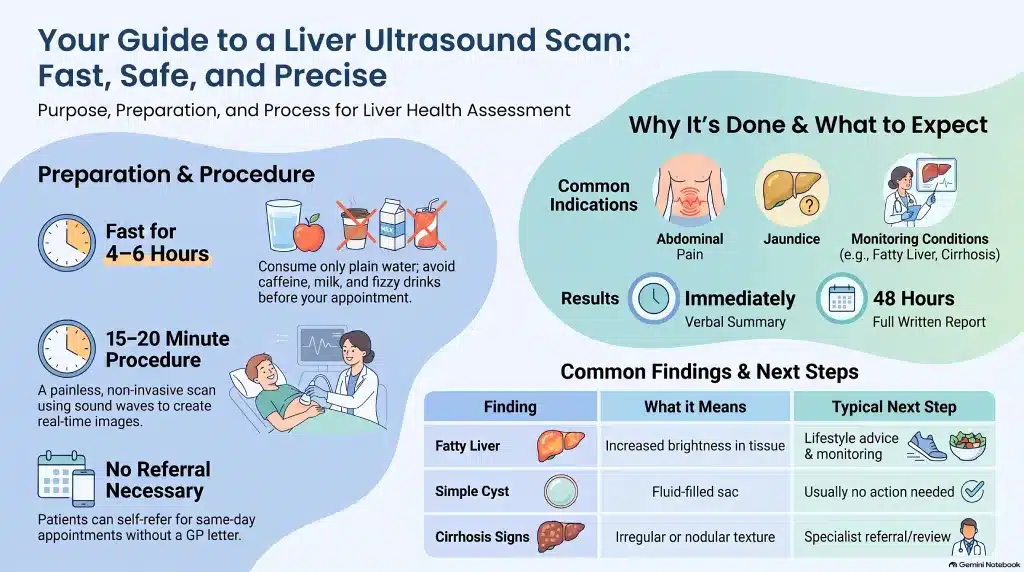
A liver ultrasound scan is a quick, painless test that checks your liver’s size, structure and surrounding organs for early signs of disease — usually done in 15–20 minutes, with no GP referral needed and a written report ready within 24–48 hours.
Listen to summary of this page
| Your situation | What we check | Quick fact |
|---|---|---|
| Abnormal liver blood tests (raised ALT/AST) | Liver size, texture and fatty changes | First-line investigation, no radiation |
| Persistent upper right-side abdominal pain | Liver, gallbladder and bile ducts | Scan usually takes 15–20 minutes |
| Jaundice or unexplained weight loss | Liver structure and nearby organs | Same-day appointments, self-referral accepted |
| Monitoring a known liver condition | Changes over time (fatty liver, cirrhosis) | Written report within 24–48 hours |
Definition & Overview
A liver ultrasound scan uses high-frequency sound waves to build a real-time picture of your liver, without needles, dye or radiation. A sonographer moves a small probe over your upper abdomen, and the returning sound waves are converted into live images on screen. Alongside the liver itself, the scan gives your clinician a clear view of its size, structure and the organs around it, including the gallbladder, bile ducts and, where relevant, the kidneys, spleen and pancreas.
Because it’s fast, safe and widely available, ultrasound is usually the first imaging test doctors turn to when investigating a suspected liver problem, before more involved tests such as a CT, MRI or biopsy are considered.
When & Why You Need a Liver Ultrasound
Indications
You might be referred for — or choose to book — a liver ultrasound if you have persistent pain in the upper right side of your abdomen, abnormal results on a liver enzyme or blood test, jaundice or unexplained weight loss, or known risk factors such as obesity, regular alcohol use or fatty liver disease. It’s also commonly used to monitor an existing liver condition over time.
Benefits
Because it’s quick, painless and radiation-free, a liver ultrasound can be repeated safely as often as your clinician needs — useful if you’re monitoring a condition rather than having a one-off check.
Limitations
It isn’t a perfect test for every patient. Results are partly dependent on the sonographer’s skill and, as the table below shows, on your body type — and a clear scan can’t always rule out disease on its own. Standard ultrasound is also less sensitive to mild fatty change; if a more precise reading is needed, techniques such as liver elastography (FibroScan) can grade the degree of fat or stiffness more accurately.
| What matters to you | Where ultrasound excels | Where it falls short |
|---|---|---|
| Speed & comfort | Painless, no radiation, results in minutes | — |
| Diagnostic certainty | Excellent first look at liver health | Can’t always give a definitive diagnosis alone |
| Body type | Works well for most patients | Image clarity can drop with higher BMI or bowel gas |
| Access | Self-referral, no GP letter required | — |
What the Scan Examines
Liver Structure
The sonographer checks your liver’s size, shape and surface texture, and looks at its echogenicity — how bright or dark the tissue appears — since changes here can point to fatty change or fibrosis.
Common Findings
Many findings are picked up by accident during a routine scan and are entirely harmless; others need monitoring or a referral. The table below covers the ones we see most often, and what typically happens next.
Surrounding Structures
Because the liver sits close to several other organs, the scan also assesses the gallbladder and bile ducts for stones or blockages, the portal vein and blood vessels running through the liver, and — where clinically relevant — the kidneys, spleen and pancreas.
| Finding | What it looks like on ultrasound | Typical next step |
|---|---|---|
| Fatty liver (steatosis) | Increased brightness (echogenicity) | Lifestyle advice, repeat scan to monitor |
| Simple liver cyst | Well-defined, fluid-filled sac | Usually no action needed |
| Haemangioma (benign tumour) | Well-defined bright lesion | Usually monitored, rarely treated |
| Cirrhosis signs | Nodular surface, irregular texture | Referral for further imaging or specialist review |
| Gallstones / bile duct blockage | Stones visible, ducts appear dilated | Referral for treatment |
Preparation & Procedure
Preparation
You’ll usually be asked to fast for 4–6 hours before your scan, as an empty stomach reduces bowel gas and gives a clearer image. Stick to plain water rather than tea or coffee — caffeine can cause the gallbladder to contract, which affects how clearly it can be assessed. Keep taking your regular medication unless told otherwise, and let the clinic know if you have diabetes or another condition that affects fasting. Wear something comfortable that gives easy access to your upper abdomen.
| Do | Avoid |
|---|---|
| Fast for 4–6 hours before your appointment | Milk-based or fizzy drinks, alcohol |
| Drink plain water if you’re thirsty | A heavy meal in the hours beforehand |
| Wear loose, separate top and bottom layers | One-piece outfits that are hard to lift |
| Tell the team about medication or diabetes | Skipping insulin or medication without advice |
Procedure Step-by-Step
On arrival you’ll be briefed on what to expect, then asked to lie on your back while gel is applied to your upper abdomen. The sonographer moves the probe over the area, occasionally asking you to hold your breath or shift position for a clearer view. The scan typically takes 15–20 minutes, a little longer if other areas need assessing.
What You Feel & Safety
The scan is generally painless; you may feel gentle pressure as the probe moves over your skin, and the gel can feel cool at first. There’s no radiation involved at any point. According to Liver UK (formerly the British Liver Trust):
“Ultrasound scans are very safe and do not hurt.”
Results & What Happens Next
Receiving Results
Many clinics, including Phoenix Ultrasound, can give you a brief verbal summary straight after the scan, with a full written report following within 24–48 hours.
Normal Findings
A normal result means your liver is within its expected size range, with a smooth surface, uniform echogenicity throughout, and no focal lesions such as cysts or masses.
Abnormal Findings & Referral
If the scan picks up fatty infiltration, cysts, masses or signs of cirrhosis, the next step is usually a specialist referral, further imaging such as a CT or MRI, additional blood tests, or practical lifestyle advice — your clinician will talk you through exactly what’s needed.
| What we look for | Normal finding | Possible abnormal finding |
|---|---|---|
| Size & shape | Within normal limits | Enlarged (hepatomegaly) or shrunken |
| Surface | Smooth | Nodular or irregular (possible cirrhosis) |
| Texture (echogenicity) | Uniform | Patchy or unusually bright (fatty change) |
| Focal lesions | None seen | Cysts, haemangiomas or other masses |
| Gallbladder & bile ducts | Clear, no blockage | Gallstones or duct dilation |
Why Choose Us in London
Our Central London clinic in Holborn is easy to reach, with a second clinic in Banstead, Surrey. Sonographers and consultant radiologists here bring over ten years of experience to every scan, and the clinic holds a 4.9 Trustpilot rating, verified over the past 12 months. We also work with the Central Surrey Primary Care Network on NHS-referred liver ultrasound and elastography — a sign of genuine liver-specific expertise, not just general imaging.
Booking is same-day with no GP referral, pricing is transparent, and if anything needs following up, we set out the next step clearly rather than leaving you to guess.
Pricing, Booking & FAQs
Pricing
Private liver ultrasound scans in London typically start from around £150 as a guide, based on comparable private abdominal-area scans — the exact fee can vary depending on whether extra organs or advanced techniques (such as liver elastography) are included. [Amin/clinic: this is a placeholder based on a general reference price, not a confirmed liver-specific figure — please insert Phoenix Ultrasound’s actual current price for this exact scan before publishing.]
| Scan | Guide price | What’s included |
|---|---|---|
| Liver ultrasound scan | From £150* | Scan, sonographer’s verbal summary, written report |
*Placeholder guide price only, based on comparable private abdominal ultrasound pricing in London — please confirm and replace with the exact liver ultrasound scan price before this page goes live.
Booking
You can book online or by phone, with no GP referral required. Appointments are available on weekdays and weekends at both our Central London and Surrey clinics, so you can usually get seen within days rather than weeks.
Leave a Reply