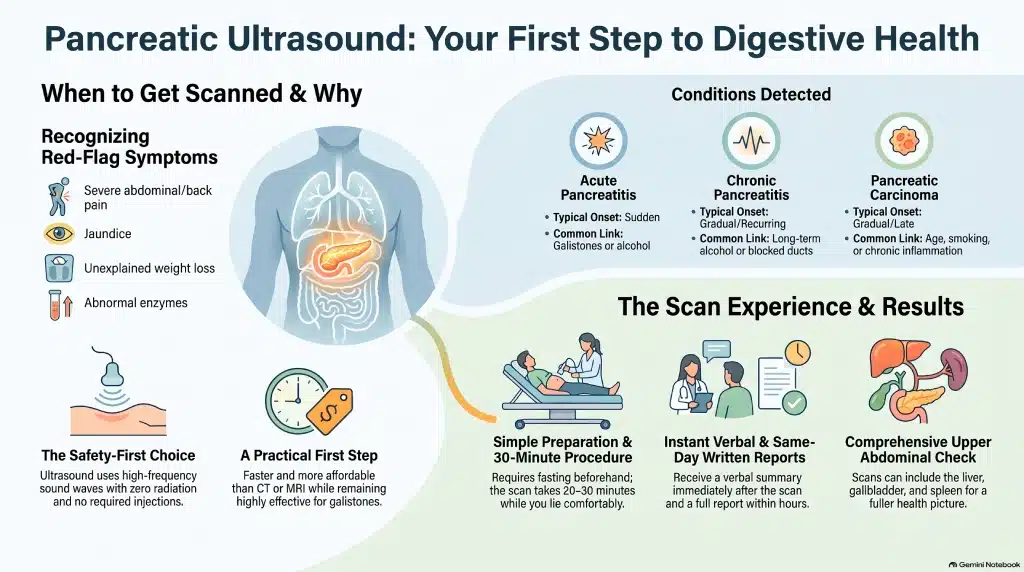
A pancreatic ultrasound is a 20–30 minute, radiation-free scan that checks the pancreas, its duct and nearby organs for inflammation, stones, cysts and tumours, with results explained the same day.
Hear the summary of the text below from the following voice:
| Your situation | What we check | Quick rule |
|---|---|---|
| Abdominal or back pain, raised pancreatic enzymes | Pancreas size and texture, ducts, gallstones | Book within a few days; go to A&E if pain is sudden and severe |
| Jaundice or unexplained weight loss | Pancreatic head, bile ducts, liver | See a doctor promptly for jaundice; we’ll scan quickly alongside that review |
| Known chronic pancreatitis or gallstones | Structural changes, ducts, pseudocysts | Repeat scans track changes over time |
| Family history of pancreatic cancer | Baseline pancreas structure | Discuss risk-based monitoring with your doctor |
Definition
A pancreatic ultrasound — also called pancreatic imaging ultrasound or an abdominal pancreas ultrasound — uses high-frequency sound waves to build a live picture of the pancreas, its duct, and surrounding structures: the liver, bile ducts and major vessels. It looks for inflammation, structural change, stones, cysts and tumours. Compared with CT or MRI, it carries no radiation, needs no injection, and typically costs less — a practical first step before more detailed imaging.
Ultrasound isn’t routine screening — it’s requested for specific symptoms, risk factors and follow-up scenarios.
Indications & Clinical Scenarios
| Symptom or risk factor | Why it prompts a scan |
|---|---|
| Severe abdominal or back pain | Common presentation of acute pancreatitis or gallstone disease |
| Jaundice or unexplained weight loss | Possible sign of a blockage or tumour affecting the pancreatic head — see a doctor promptly; don’t wait to self-book |
| Abnormal pancreatic enzyme results | Blood test flags inflammation that imaging can help explain |
| Chronic pancreatitis or gallstone history | Monitors known structural changes and complications |
| Family history of pancreatic cancer | Supports risk assessment and baseline imaging |
Benefits & Limitations vs Alternative Imaging
Main benefits: no radiation, fast access, lower cost than CT or MRI. Main limitation: image quality drops with a higher body weight or excess bowel gas, and very small lesions can be missed.
Comparisons with Other Modalities (CT, MRI, MRCP, EUS)
| Modality | Radiation | Best for |
|---|---|---|
| Ultrasound | None | First-line check, gallstones, general structure |
| CT | Yes (X-ray based) | Detailed staging, complications, unclear ultrasound findings |
| MRI / MRCP | None | Duct detail and soft-tissue contrast |
| EUS (endoscopic ultrasound) | None | Highest accuracy for small lesions; more invasive |
The main reason ultrasound is tried first is safety, not just cost. According to the NHS:
“Ultrasound scans do not use any radiation, unlike in X-rays or CT scans.”
When it can’t give a clear enough answer on its own, CT, MRCP or EUS fill the gap — EUS is more invasive but highly accurate for very small lesions.
What Your Scan Includes
Most appointments take 20–30 minutes and follow the same core steps:
- Fasting beforehand and avoiding gas-forming foods and drinks
- Lying on your back, and sometimes on your side, on the exam couch
- A curvilinear abdominal probe scanning the pancreatic head, body and tail, the duct, and nearby liver, bile ducts and vessels
- Doppler views of blood flow if we need to check the vessels near the pancreas
- A verbal summary at the end, followed by a full digital or printed report
What to Expect on the Day
- Arrival and quick registration
- Adjusting clothing to expose your upper abdomen
- Short breath-holds at points during the scan
- A mild sensation of pressure from the probe — no pain, no needles
- A verbal summary before you leave, with the full report to follow
Instant Results & Same-Day Reporting
You don’t wait days to find out what we saw. The sonographer talks you through the findings straight after the scan, and your written report follows the same day.
Who Performs the Scan & Our Equipment
Your scan is carried out by an HCPC-registered sonographer or a consultant radiologist, using diagnostic ultrasound machines with Doppler capability. Many also work within NHS hospitals, so the same expertise is here without the wait.
Safety, Limitations & Contraindications
Pancreatic ultrasound is safe, non-invasive and radiation-free. Limitations are technical, not medical: bowel gas, higher body weight and poor acoustic windows can obscure the view, and very small ductal lesions may be missed. Recent abdominal wounds or trauma may make scanning unsuitable — we’ll recommend CT or MRI if the images aren’t conclusive.
Conditions Detected by Pancreatic Ultrasound
A pancreatic ultrasound can reveal conditions ranging from short-term inflammation to structural disease.
Acute Pancreatitis
Sudden inflammation of the pancreas, most often triggered by gallstones or alcohol, causing severe upper abdominal pain.
Chronic Pancreatitis
Progressive, long-term inflammation that permanently damages pancreatic tissue, usually linked to alcohol use or blocked ducts.
Fatty Pancreas
A build-up of fat within the pancreas, often an incidental finding tied to metabolic syndrome, alcohol use or a past viral infection.
Pancreatic Pseudocysts
Fluid-filled collections that typically develop as a complication of pancreatitis, occasionally needing drainage if they cause pain or press on nearby organs.
Pancreatic Carcinoma
The most common pancreatic tumour, frequently arising in the head of the pancreas; jaundice, weight loss and abdominal pain are the classic warning signs.
| Condition | Typical onset | Often linked to |
|---|---|---|
| Acute pancreatitis | Sudden | Gallstones, alcohol |
| Chronic pancreatitis | Gradual, recurring | Long-term alcohol use, blocked ducts |
| Fatty pancreas | Incidental finding | Metabolic syndrome, alcohol, viral infection |
| Pseudocyst | Weeks after pancreatitis | Complication of acute or chronic pancreatitis |
| Pancreatic carcinoma | Gradual, often late-presenting | Age, smoking, chronic pancreatitis |
Comprehensive Upper Abdominal Assessment (Pancreas, Liver, Gallbladder & Spleen)
Because the pancreas sits close to the liver, gallbladder and spleen, the same visit can also check these organs for cysts, gallstones or other abnormalities — a fuller picture in one appointment rather than several.
No GP Referral Needed
You don’t need a GP referral to book. Self-referral means you can arrange a scan as soon as symptoms start, rather than waiting on an appointment and referral letter — we’re happy to send your results to your GP with consent.
Same-Day Appointments & Flexible Booking
We offer same-day and next-day appointments alongside evening and weekend slots, so a scan can fit around work or family life.
Pricing & Booking
Pricing Ultrasound Scan depends on whether you book a standalone pancreatic scan or a wider upper abdominal check; current prices are confirmed at booking. Book online or by phone — same-day or next-day slots are often available, with your report ready the same day.
| Option | What’s included | Best if… |
|---|---|---|
| Pancreatic ultrasound only | Pancreas, duct and immediate surroundings | You have a specific symptom or referral |
| Pancreas + upper abdomen package | Pancreas, liver, gallbladder, spleen | You want a broader check in one visit |
| Same-day or weekend slot | Priority scheduling outside office hours | You need results quickly or can’t attend on a weekday |
Our Clinicians and Specialist Team
Our sonographers and radiologists hold recognised UK qualifications and professional memberships, and many continue to practise within NHS hospitals alongside their work here — bringing hospital-level experience to a private appointment.
Consultation & Aftercare
Before you leave, you can ask questions about what was found and what it means. If further tests or a referral are needed, we’ll talk you through the options rather than simply handing over a report.
CQC-Certified & Clinician Governance
The clinic is registered with the Care Quality Commission, and our specialists are regulated by the relevant UK medical bodies, bringing decades of combined clinical experience to every scan.
Patient Experience & Reviews
Patients rate their experience highly on independent platforms such as Google Reviews and Doctify — you’re welcome to check verified reviews there before you book.
References
Informed by clinical guidance from the NHS and Cancer Research UK: see the NHS overview of acute pancreatitis and Cancer Research UK’s pancreatic cancer symptoms guide.
Leave a Reply