Penile ultrasound is a non-invasive imaging test that uses high-frequency sound waves to assess the structure and blood flow of the penis. This diagnostic tool plays a crucial role in evaluating erectile dysfunction (ED), Peyronie’s disease, penile trauma, and vascular abnormalities. If you are experiencing persistent erectile issues, pain, curvature, or swelling in the penis, your doctor may recommend a penile Doppler ultrasound to identify underlying conditions.
This blog explores the causes of penile health issues, benefits of the scan, what to expect during the procedure, and how it aids in diagnosis.
| Quick Overview | Details Based on This Article |
|---|---|
| Main Topic | Purpose, benefits, procedure, and diagnostic role of penile ultrasound. |
| What Is a Penile Ultrasound? | A non-invasive imaging test using high-frequency sound waves to assess penile structure and blood flow. |
| Primary Uses | Evaluation of erectile dysfunction, Peyronie’s disease, penile trauma, vascular abnormalities, and abnormal penile findings. |
| Common Symptoms Leading to the Scan |
|
| Common Causes of Penile Health Issues |
|
| Key Benefits |
|
| Type of Ultrasound Used | Penile Doppler ultrasound to evaluate arterial inflow and venous outflow. |
| Preparation Required | No special preparation; medication adjustments may be advised by the doctor if needed. |
| Procedure Overview | The scan involves gel application, probe movement over the penis, and Doppler imaging; an induced erection may be used to assess blood flow. |
| Scan Duration | The procedure typically takes 20–30 minutes. |
| What the Scan Can Diagnose |
|
| Cost Range | Typically ranges from £250 to £600, depending on location and healthcare provider. |
| Key Takeaway | Penile ultrasound is a fast, safe, and effective tool for diagnosing vascular and structural causes of penile health issues. |
Common Causes of Penile Health Issues
Several conditions can affect penile health, leading to symptoms such as pain, erectile dysfunction, and abnormal curvature. Some of the most common causes include:
- Erectile Dysfunction (ED) – Caused by poor blood circulation, nerve damage, diabetes, high blood pressure, or psychological factors.
- Peyronie’s Disease – Development of fibrous plaques in the penis, leading to curvature and pain.
- Venous Leakage – When veins in the penis fail to keep blood trapped, causing erection difficulties.
- Penile Trauma – Injury from accidents, sports, or sexual activity can cause internal damage.
- Vascular Disease – Conditions like atherosclerosis can restrict blood flow, affecting erection quality.
- Priapism – Prolonged erections that do not subside naturally, potentially leading to permanent damage.
- Penile Tumors or Masses – Abnormal growths that require further investigation.

Benefits of a Penile Ultrasound
A penile ultrasound offers numerous advantages, making it a valuable diagnostic tool:
- Non-invasive and painless – No surgical procedures involved.
- Real-time blood flow assessment – Detects vascular abnormalities affecting erections.
- Detects fibrosis and plaques – Helps diagnose Peyronie’s disease.
- Assesses penile trauma – Identifies internal injuries.
- Guides treatment decisions – Helps doctors recommend medications, surgery, or lifestyle changes based on results.
- Quick and efficient – Takes only 20-30 minutes with immediate preliminary findings.
What to Expect During the Scan
A penile Doppler ultrasound is a specialized technique that evaluates blood circulation in the penis. It helps differentiate between arterial insufficiency and venous leakage, two common causes of erectile dysfunction. According to mskcc.org:
A penile ultrasound needs to be done while you have a rigid (hard) erection. It’s important to get to your appointment on time. This allows for enough time to make sure you have a rigid erection.
During your appointment, you may see a nurse practitioner (NP), registered nurse (RN), fellow (doctor), or all 3.
Preparation:
- No special preparation is needed.
- Avoid taking medications like blood thinners before the test if advised by your doctor.
Procedure Steps:
- Gel Application: A water-based gel is applied to the penis to enhance sound wave transmission.
- Initial Imaging: The technician moves a handheld probe over the penis in its flaccid state to capture baseline images.
- Induced Erection (if needed): A small dose of vasoactive medication (such as alprostadil) may be injected to evaluate changes in blood flow during an erection.
- Doppler Imaging: The probe measures blood velocity, detects blockages, and checks for venous leakage.
- Completion: The procedure lasts 20-30 minutes, and results are analyzed by a radiologist or urologist.
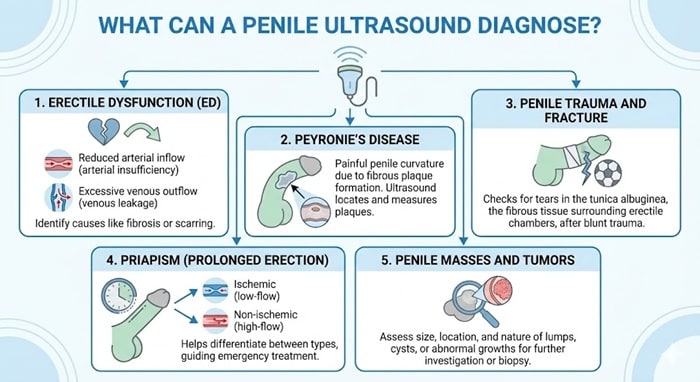
What Can a Penile Ultrasound Diagnose?
1. Erectile Dysfunction (ED)
A penile ultrasound for ED helps identify:
- Reduced arterial inflow (arterial insufficiency)
- Excessive venous outflow (venous leakage)
- Penile fibrosis or scarring
2. Peyronie’s Disease
This condition is characterized by painful penile curvature due to fibrous plaque formation. A penile ultrasound can locate and measure these plaques, helping guide treatment options such as injections or surgery.
3. Penile Trauma and Fracture
Men who suffer blunt trauma or a suspected penile fracture may undergo an ultrasound to check for tears in the tunica albuginea, the fibrous tissue surrounding the erectile chambers.
4. Priapism (Prolonged Erection)
A penile Doppler ultrasound helps differentiate between ischemic (low-flow) and non-ischemic (high-flow) priapism, guiding emergency treatment.
5. Penile Masses and Tumors
If lumps, cysts, or abnormal growths are detected, an ultrasound can assess their size, location, and whether they require further investigation or biopsy.
Penile Ultrasound Cost and Availability
The cost of a penile ultrasound varies based on location and healthcare provider. In the U.S., the price typically ranges between £250 and £600. Many clinics and hospitals offer this service, and searching “penile ultrasound near me” can help you find a diagnostic center.
Frequently Asked Questions (FAQs)
- Is a penile ultrasound painful?
No, the procedure is non-invasive and painless. However, if an injection is given, mild discomfort may occur.
- How long does a penile ultrasound take?
The test typically takes 20-30 minutes.
- Can a penile ultrasound detect cancer?
Yes, it can help identify penile masses or tumors, but additional tests like a biopsy may be required for confirmation.
- Will my insurance cover a penile ultrasound?
Many insurance plans cover penile Doppler ultrasound tests, especially if medically necessary. Check with your provider.
- What should I do if my ultrasound results show abnormalities?
Your doctor may recommend further testing or treatment options such as medications, lifestyle changes, or surgery
- Do I need to fast before a penile ultrasound?
No. Fasting is not required, and you can eat and drink normally before the examination.
- Is a penile ultrasound performed by a radiologist or a urologist?
The scan itself is usually performed by a trained sonographer, while the results are interpreted by a radiologist or urologist.
- Can anxiety or stress affect the results of a penile Doppler ultrasound?
Emotional stress can influence erectile response, which is why the test focuses on measurable blood flow rather than subjective erection quality alone.
- Is a penile ultrasound suitable for follow-up after treatment?
Yes. Penile ultrasound is often used to monitor response to treatments such as medication, injections, or surgery.
- Can a penile ultrasound explain why medications for ED are not working?
Yes. The scan can reveal underlying vascular or structural problems that may limit the effectiveness of oral ED medications.
This post is really informative! I didn’t realize how helpful a penile ultrasound can be for diagnosing ED and Peyronie’s disease.
How accurate is a penile ultrasound in differentiating between arterial insufficiency and venous leakage?
Can penile ultrasound help monitor progress after treatment for Peyronie’s disease or ED
Good info here. I’ve been putting this off because I was terrified it would be painful, but knowing it’s mostly just gel and a probe makes me feel a bit better about booking the appointment.
Is it possible to have venous leakage even if the ultrasound looks normal? I feel like my symptoms match that perfectly but the doc said my flow was fine. Still confused.
I wasn’t really sure what a penile ultrasound involved before reading this. Some of the details about induced erections and Doppler imaging were kinda surprising — didn’t realize it could measure blood flow so precisely. The list of conditions it can detect makes sense, though it’s a lot to take in at once. I guess it’s mostly for people with ongoing issues rather than occasional problems. The cost section was helpful too; £250–£600 seems higher than I expected, but I suppose that includes the specialist’s time. Overall, it’s practical info, though some parts feel a bit clinical and heavy for a casual read.
if someone has mild ED only occasionally, is this scan usually recommended, or is it mostly for persistent problems? I’m not sure when doctors decide it’s worth doing. I get the idea that it checks blood flow and structure, but it seems a bit intimidating with injections and induced erections. The article mentions it’s painless mostly, but I imagine that part could make some guys nervous. Also curious if age or general health affects whether they suggest it sooner rather than later.