
Rotator cuff
Look for tears, thickening and tendinitis in the cuff tendons.

Ultrasound shows tendons and muscles while you move, which is exactly what an X-ray cannot do. Often the clearest first look at shoulder pain.
Tendons and muscles, in real time.Choose your clinic and view appointment options in our online booking system.
Explore your appointmentHear from people
who have visited us.

An X-ray shows bone. Ultrasound shows the tendons, muscles and bursae around the joint — and it shows them moving, which is often what makes the diagnosis.
Look for tears, thickening and tendinitis in the cuff tendons.
Check for bursitis and watch the tendon as you lift the arm.
Assess the long head of biceps for tears, fluid or instability.
Look at the joint for effusion, calcification and signs of inflammation.
A Shoulder & Upper Arm Ultrasound Scan is a non-invasive imaging test used to evaluate the soft tissues, joints, and structures in the shoulder and upper arm. This scan is highly effective for diagnosing conditions such as tendon tears, muscle injuries, bursitis, and joint issues, providing a real-time, dynamic view of the shoulder’s function and structure.
Hear the summary of the text below from the following voice:
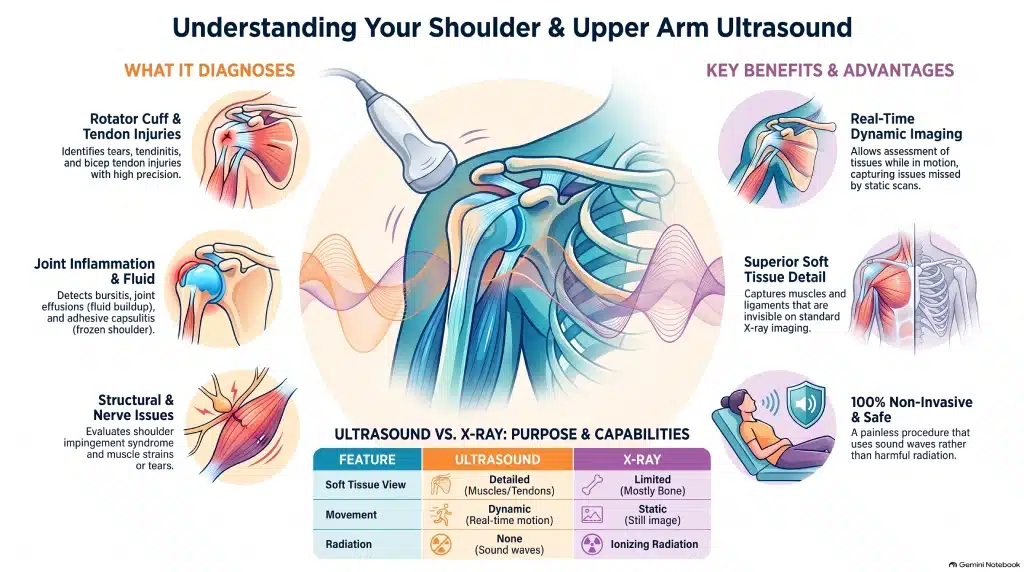
A Shoulder & Upper Arm Ultrasound uses high-frequency sound waves to produce images of the muscles, tendons, ligaments, and joints in the shoulder and upper arm. This scan is commonly used to assess:
The ultrasound provides a detailed view of the shoulder’s dynamic movement, which is particularly helpful in diagnosing issues that may be missed with other imaging methods like X-rays or CT scans.
This scan plays a vital role in diagnosing shoulder and upper arm conditions, especially for:
| Condition / Structure | What the Ultrasound Assesses |
|---|---|
| Rotator Cuff | Tendon tears, tendinitis, and related soft tissue injuries |
| Shoulder Bursa | Inflammation and fluid accumulation associated with bursitis |
| Shoulder Joint | Joint effusions, fluid buildup, and structural abnormalities |
| Shoulder Tendons | Tendon inflammation, tears, and movement-related problems |
| Biceps Tendon | Tendon injuries, inflammation, and possible tears |
| Shoulder Muscles | Muscle tears, strains, and soft tissue injuries |
| Upper Arm Soft Tissues | Muscle injuries, swelling, and other soft tissue abnormalities |
A Shoulder & Upper Arm Ultrasound is recommended for individuals who experience:
If you are experiencing shoulder pain, discomfort in the upper arm, or have suffered an injury, a Shoulder & Upper Arm Ultrasound Scan can provide essential insights for a precise diagnosis and effective treatment. Schedule your scan today to get a comprehensive evaluation of your shoulder and upper arm health.
From getting ready to discussing what comes next, here is a simple guide to your appointment.
A question before you book? Call usWhen the pain started, what makes it worse, any injury, and which movements you cannot do. This directs the scan.
You sit on a stool while gel is applied and the probe is moved over the shoulder. You will be asked to move your arm into a few positions so the tendons can be watched under load. It takes about 20 to 30 minutes.
Ask what was found, whether physiotherapy, an injection or further imaging is the usual next step, and who should receive the report.
Choose the location that works for you. Confirm your selected clinic in the booking system before completing your appointment.
Need something more personal?
Speak to the team before booking.
For the rotator cuff, bursae and biceps tendon, ultrasound is quick, detailed and lets the sonographer watch the tendon move under load. MRI sees inside the joint and the bone, so it answers different questions. Many people start with ultrasound; the report will say if MRI is advised.
No. You can book directly, and a written report is prepared for you to take to your GP, physiotherapist or orthopaedic consultant.
Book the side that hurts. If you want both compared — for example with a long-standing problem or an occupational assessment — choose the two-sides option in the booking form.
Yes. The booking system lists shoulder with elbow and forearm, and with wrist and hand, for one or both sides. These appointments are longer, so choose the combination before booking rather than on the day.
It should not. The probe presses on the area and you will be asked to move your arm, which can be uncomfortable if the shoulder is already painful. Tell the sonographer and they will adjust.
A detailed report is normally ready within 24 hours and sent to you.
You may need a shoulder ultrasound scan if you experience one or more of the following signs and symptoms:
• Pain in the shoulder region, during movement or sporting activities.
• Pain in the shoulder region at night, disturbing when sleeping on the side.
• Limited range of motion, that may affect simple activities such as dressing, lifting the arm, carrying or using strength.
• Pain may extend from the neck and down the upper arm.
• Pain or limited range of motion after an injury or accident.
• Unable to progress training or to achieve nominal performance.
• Discomfort during sport or at the end of an active day.
If you’re experiencing any of these symptoms, consider scheduling a shoulder ultrasound scan for a thorough evaluation at Phoenix Ultrasound. Early detection can lead to timely intervention and better outcomes.
During this ultrasound scan, our specialist sonographer will assess the whole shoulder region using ultrasound technology.
The appointment encompasses the following:
• Relevant Medical History: We will gather information about your medical history and injuries to ensure a thorough assessment.
• Ultrasound Examination: We will perform a detailed ultrasound scan of the shoulder region, including the acromio-clavicular joint (ACJ), biceps tendons, rotator cuff tendons (subscapularis, supraspinatus, infraspinatus), subacromial-subdeltoid region, shoulder joint, to check for impingement (subacromial-subdeltoid, subcoracoid, etc), bursitis, rotator cuff tendons tendinopathy, tears or ruptures, joint arthritis, frozen shoulder, , or other mechanical or inflammatory issues.
• Explanation of Findings: You will receive clear explanations of all findings during and after the ultrasound scan.
• Official Report: We will provide you with an official report within 24 hours, including relevant images from your scan.
• Further Recommendations: If necessary, we may recommend a follow-up scan, referral to your GP or a specialist, or suggest additional tests such as blood test or other imaging.
At Phoenix Ultrasound, our goal is to offer a comprehensive and informative service to guide you through the diagnostic process. Your health and well-being are our top priorities.
The most common finding is shoulder impingement (also known as rotator cuff impingement or subacromial-subdeltoid impingement), which is pain and/or limited range of motion cause by the mechanical entrapment of the rotator cuff tendons during motion and can be assessed in real-time during dynamic scans.
Tendinopathy and tears of the rotator cuff tendons (supraspinatus, infraspinatus, subscapularis) or of the long head of biceps are also common, with partial or complete ruptures being more infrequent. Ultrasound scan also help diagnose frozen shoulder (adhesive capsulitis), or osteoarthritis (wear and tear) of the shoulder or acromio-clavicular joint.
At Phoenix Ultrasound, our skilled professionals are trained to identify and interpret a range of conditions, providing you with a comprehensive assessment of your health.
There is no essential preparation for this scan.
However, as the scan involves exposing the shoulder, from the neck to the upper arm, we recommend wearing clothing that allows easy access and full mobility of the shoulder.
Our ultrasound specialist will explain the procedure before starting. You will be guided to sit upright facing the sonographer and expose the shoulder region. A small amount of water-based gel will be applied to the examined area for optimal imaging.
Our specialist will move the probe on your skin to produce diagnostic ultrasound images. You may be asked to move the shoulder and arm in various positions, which helps better visualise tendons and other structures around the shoulder. Shoulder ultrasound scan is safe, non-invasive (external, onto the skin), involve no radiation, and are painless so you are not expected to feel any discomfort during your ultrasound scan.
A shoulder ultrasound scan is usually completed within 15-20 minutes. Our sonographer will provide recommendations based on the findings of the ultrasound scan.
You will receive your results verbally immediately after the scan. Following the appointment, the sonographer will review the images and prepare a written report within 24 hours, with any recommended actions.
The report and images will be sent to you, allowing you to discuss the findings with your doctor or physiotherapist if necessary.
There are no associated risks or side effects with a shoulder ultrasound scan. Ultrasound, the imaging technique used, does not involve any radiation.
This is one reason why doctors prefer ultrasound for monitoring developing babies in pregnant women.
Book your shoulder scan below. Follow the booking form’s Next buttons to continue, one step at a time.
Loading the booking form…
Calendar not displaying? You can open the booking page in a new tab ↗.
Call the teamAdding the elbow, wrist or hand? Those combinations are in the booking system and take a little longer. If you are unsure which to choose, call us on 020 3318 1373.
If you feel unwell, seek medical advice. This page is general information, not a diagnosis. For urgent concerns, contact your GP or NHS 111; in an emergency call 999.
Further reading: NHS guidance on shoulder pain · NHS guidance on frozen shoulder
Please select Appointment type and Branch location to see time slots for booking- alternatively, please contact us via the chat, call or email, 020-3318-1373
Please check what preparation is needed before your ultrasound scan below:
| All Pelvic scans Kidney and Urinary tract Prostate & Urinary Tract Appendicitis Early Pregnancy Scan | Drink One Liter of still water (2 Pints) One hour before your scan. Do NOT use the toilet so you would arrive with a full bladder. Medication can be taken as normal. |
| Liver scans Upper Abdomen Liver Fibroscan (Liver Elastography) | Do NOT eat for 6 hours prior to scan time. |
| Combination of above scans | Same as respective scan’s preparation. |


