A prostate ultrasound scan — usually a transrectal ultrasound (TRUS) — images the prostate gland to check its size, structure and blood flow, and is available privately in London and Surrey from £215 with same-day results.
Hear the summary of the text below from the following voice:
| Your question | The answer |
|---|---|
| What is it? | An ultrasound scan of the prostate, usually done transrectally (TRUS) |
| Who is it for? | Men with raised PSA, an abnormal DRE finding, or urinary symptoms |
| How long does it take? | 15-20 minutes for the scan; 30-60 minutes total appointment |
| Do I need a GP referral? | No — self-referral is accepted |
| What does it cost? | From £215 (Prostate & Bladder) up to £465 (multiparametric) |
| Where can I have it? | Central London (Holborn) or Banstead, Surrey |
What Is a Prostate Ultrasound?
A prostate ultrasound, often referred to as a transrectal ultrasound (TRUS), is a diagnostic imaging test that uses high-frequency sound waves to visualise the prostate gland and the tissue around it. According to Cancer Research UK:
“A prostate ultrasound scan can show changes in your prostate, including abnormal growths.”
At Phoenix Ultrasound, an ultrasound scan for prostate assessment builds a picture of the gland’s size and internal structure, and — when performed transrectally with colour Doppler — its blood flow too, helping identify patterns linked to enlargement, inflammation or suspicious lesions.
When and Why We Use a Prostate Ultrasound
A prostate ultrasound scan is most often requested alongside other clinical findings, rather than as a stand-alone first step. The table below covers the main reasons men are referred, or self-refer, for one.
| Reason for the scan | What it may indicate |
|---|---|
| Elevated PSA on a blood test | Possible enlargement, inflammation or, less commonly, cancer |
| Abnormal digital rectal exam (DRE) | A felt nodule or irregularity needing imaging follow-up |
| Urinary symptoms | Difficulty voiding, frequency, weak stream or incomplete emptying |
| Suspected BPH or prostatitis | Enlargement or inflammation needing confirmation |
| Biopsy guidance or monitoring | Precise targeting for a biopsy, or tracking a known condition |
What the Scan Includes
Most appointments combine two views. A transabdominal pass, through the lower abdomen with a full bladder, gives an initial look at the prostate and bladder. Where more detail is needed, a transrectal (TRUS) probe is used for close-up images of the gland itself — this is the approach most private clinics mean when they describe an “ultrasound scan for prostate” assessment.
| Approach | How it’s done | Best for |
|---|---|---|
| Transabdominal | Through the lower abdomen, bladder full | A first, non-invasive overview |
| Transrectal (TRUS) | Small probe inserted into the rectum | Detailed prostate size, structure and blood flow |
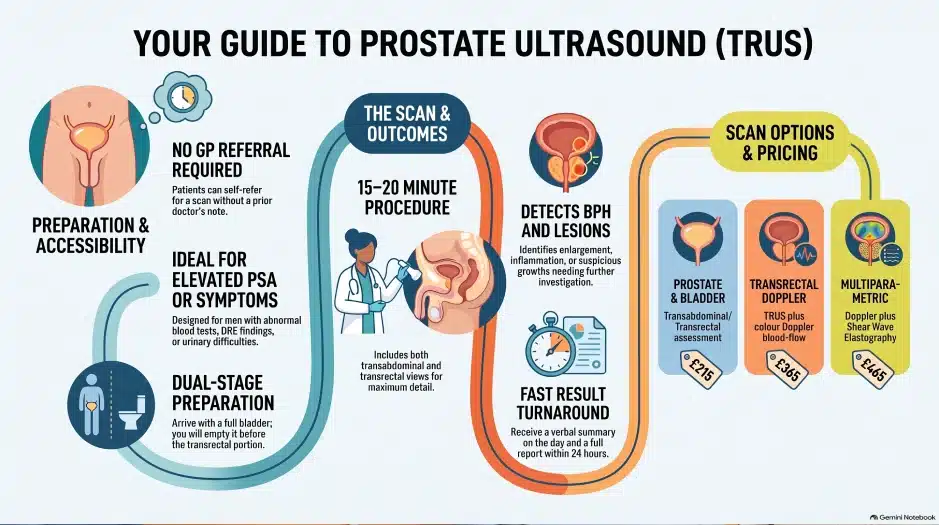
The scan itself typically takes 15-20 minutes; allow 30-60 minutes for the full appointment, including check-in and a brief discussion of what was seen.
What to Expect on the Day
You’ll arrive at the clinic and change into a gown from the waist down. A trained sonographer or radiologist explains the procedure and asks you to sign consent before any internal scanning. For the transabdominal part, drink about a litre of water an hour beforehand and avoid the toilet, so you arrive with a comfortably full bladder; you’ll then be asked to empty it before the transrectal portion. You’ll usually lie on your side with your knees drawn up while the probe, covered with a protective sheath and gel, is gently inserted. Most men feel pressure or discomfort rather than sharp pain — this varies between individuals but is brief. Afterwards you can resume normal activities straight away, with a verbal summary given on the day and a full written report usually following within 24 hours.
Who Performs the Scan & Equipment Used
Your scan is carried out by an HCPC-registered sonographer or a consultant radiologist with dedicated ultrasound training, using high-resolution equipment with transrectal probe capability built for pelvic and prostate imaging. The clinic operates under CQC registration, following recognised governance protocols for diagnostic imaging.
Conditions Detected & Diagnostic Value
| Condition | What the scan assesses |
|---|---|
| Benign prostatic hyperplasia (BPH) | Gland enlargement linked to urinary symptoms |
| Prostate cancer suspicion | Suspicious nodules or lesions, especially with raised PSA or MRI findings |
| Prostatitis | Signs of inflammation or infection, though usually needs further tests |
| Calcifications or cysts | Structural changes within the gland |
| Biopsy planning | Ultrasound guidance for accurate needle placement |
Safety and Limitations
This scan is a diagnostic imaging tool, not a substitute for specialist assessment. Where cancer is suspected, a urologist will usually still need a biopsy to reach a definite diagnosis. A prostate ultrasound uses no ionising radiation, making it a safer alternative to X-ray-based imaging. The transrectal probe can cause brief discomfort — it isn’t entirely non-invasive — and image quality can be affected by prostate size, calcification or individual anatomy. Importantly, a clear scan (or even a clear biopsy) doesn’t fully rule out disease, especially prostate cancer, so your clinician may still recommend ongoing monitoring or further imaging.
Pricing & Booking
Phoenix Ultrasound offers three levels of prostate ultrasound scan london patients can choose from, depending on how much detail your clinician needs:
| Scan type | What’s included | Price |
|---|---|---|
| Prostate & Bladder Ultrasound | Transabdominal/transrectal assessment of prostate size, structure and bladder | £215 |
| Prostate Transrectal Colour Doppler | Detailed TRUS plus colour Doppler blood-flow assessment | £365 |
| Transrectal SWE & Colour Doppler (multiparametric) | Doppler scan plus Shear Wave Elastography for tissue stiffness | £465 |
Note: the multiparametric option combines ultrasound-based Doppler and elastography techniques — it is not the same test as a multiparametric MRI (mpMRI), which some men have as a separate step in their diagnostic pathway.
No GP referral is needed — self-referral is accepted — and same-day or next-day appointments are usually available. Flexible payment, including interest-free instalments via Klarna, is offered on all scans.
Locations
Appointments run at two Phoenix Ultrasound clinics: Central London, at 1 Portpool Lane, Holborn, EC1N 7UU, and Banstead, Surrey, at 63 Nork Way, SM7 1HL. The team can be reached by phone and text seven days a week, from 7am to 10pm.
Our Clinicians & Specialist Team
Scans are performed by consultant radiologists and sonographers with both NHS and private-sector backgrounds, holding accreditation in urological imaging. Results feed into a wider multidisciplinary approach, so your findings can support any ongoing urology consultation or management plan.
References & Governance
Phoenix Ultrasound operates under CQC regulation and follows established clinical protocols for prostate ultrasound and TRUS-guided procedures, in line with national diagnostic imaging practice. Every report is reviewed by a qualified consultant before it reaches you, so findings can be integrated confidently into your wider prostate care.
Leave a Reply