An abdominal ultrasound is a painless, radiation-free scan that checks your liver, gallbladder, pancreas, spleen, kidneys, bladder and aorta for problems such as gallstones, cysts or organ enlargement.
| At a glance | Details |
|---|---|
| Organs checked (as a category) | Liver, gallbladder, pancreas, spleen, kidneys, bladder, abdominal aorta — exact coverage depends on the package (see below) |
| Price | From £190 for the Upper Abdominal scan (liver, gallbladder, pancreas, spleen, kidneys); bladder/urinary tract needs the KUB or combined package, from £185 |
| Duration | 20–30 minutes |
| Preparation | Fast 6–8 hours; water only |
| Results | Verbal summary same day; full report within 24 hours |
| GP referral | Not required — self-refer directly |
| Locations | Central London (Holborn) & Banstead, Surrey |
What Is an Abdominal Ultrasound Scan?
An abdominal ultrasound is a non-invasive, radiation-free diagnostic scan that uses sound waves to examine the organs inside your abdomen — the liver, gallbladder, pancreas, spleen, kidneys, bladder and abdominal aorta (AAA). It helps identify the cause of abdominal pain, inflammation, gallstones, cysts or organ enlargement, often before symptoms become serious.
When and Why We Use Abdominal Ultrasound
Common Indications and Clinical Scenarios
An abdominal ultrasound scan is commonly used to investigate:
- Abdominal pain, bloating or tenderness
- Jaundice (yellowing of the skin or eyes)
- Abnormal liver or kidney blood test results
- Unexplained weight loss or urinary symptoms
- Suspected gallstones, cysts or fatty liver disease
- Abdominal aortic aneurysm (AAA) checks — the NHS national screening programme targets men aged 65+, but a private scan can be booked at any age if you have risk factors or want peace of mind — or to monitor a known condition
Preventive and Health-Screening Applications
Beyond investigating symptoms, an abdominal ultrasound is a popular addition to an annual health check, giving reassurance about organ health well before a problem would otherwise be noticed — particularly useful if you have a family history of liver, kidney or gallbladder disease.

Benefits vs Alternative Imaging
Ultrasound is usually the first imaging test offered because it’s quick, affordable and involves no radiation. A CT or MRI scan may be used afterwards if a more detailed, three-dimensional view is needed.
Scan Package Options
Clinics typically offer a few tiers depending on how much of the abdomen needs to be assessed. Our Upper Abdominal Ultrasound Scan covers the liver, gallbladder, pancreas, spleen and kidneys; a Full Abdominal or KUB (kidneys, ureters and bladder) scan adds the lower urinary tract; and combined packages extend into the pelvis. Men investigating urinary or prostate symptoms alongside abdominal pain often choose the Abdominal, Prostate & Bladder and Urinary Tract Ultrasound, which combines all three areas in one appointment.
What Your Scan Includes
- Pre-scan preparation: fast for 6–8 hours; water only — no food, milk, coffee, tea or fizzy drinks. Some scans require a full bladder — follow your booking instructions.
- Procedure: a water-based gel is applied and a transducer moved across the abdomen while you lie flat or on your side.
- Organs examined: liver, gallbladder, pancreas, spleen, kidneys, bladder and abdominal aorta, with optional Doppler assessment of blood flow if clinically relevant.
- KUB variant: includes kidneys, ureters and bladder with pre- and post-void measurements.
- Duration: around 20–30 minutes.
- Deliverables: a same-day verbal summary and a full digital report within 24 hours, which can be securely shared with your GP or consultant on request.
What to Expect on the Day
Who Performs the Scan & Equipment Used
Scans are performed by HCPC-registered sonographers or consultant radiologists, many of whom also work within the NHS. Clinics use high-resolution 2D/Doppler ultrasound systems to ensure accuracy and diagnostic confidence.
Safety, Limitations & Contraindications
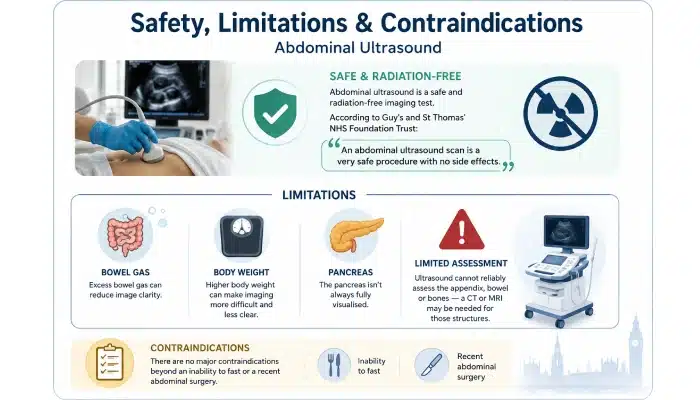
Abdominal ultrasound is safe and radiation-free. According to Guy’s and St Thomas’ NHS Foundation Trust:
“An abdominal ultrasound scan is a very safe procedure with no side effects.”
That said, image clarity can be reduced by bowel gas or a higher body weight, and the pancreas isn’t always fully visualised. Ultrasound also cannot reliably assess the appendix, bowel or bones — a CT or MRI may be needed for those structures. There are no major contraindications beyond an inability to fast or a recent abdominal surgery.
Pricing & Booking
Private abdominal ultrasound prices across London typically range from around £145 to £250 depending on the scan type and provider. At Phoenix Ultrasound, the standard Upper Abdominal scan is £190, with package upgrades available if you also need your pelvis or urinary tract assessed (see the table above). No GP referral is required, same-day and next-day appointments run seven days a week including evenings, and digital reports are delivered within 24 hours. Booking is via our secure online form or by phone, with clear payment, insurance and cancellation terms shown on each scan page.
Locations
Phoenix Ultrasound scans are available at two clinics:
- Central London: 1–5 Portpool Lane, Holborn, London, EC1N 7UU
- Surrey: 63 Nork Way, Banstead, SM7 1HL
Call 020 3318 1373, Monday to Sunday, 7am–10pm, to book at either branch.
References & Governance
Phoenix Ultrasound is CQC-registered and follows BMUS (British Medical Ultrasound Society) and NHS best-practice standards. All sonographers are HCPC-certified, and patient data is handled under UK GDPR. Where a scan identifies an abnormal finding, patients are guided through the appropriate onward referral pathway.
Our Clinicians & Specialist Team
Our abdominal imaging service is led by HCPC-registered sonographers and consultant radiologists, many of whom also work within the NHS, bringing 10 to 20 years of diagnostic experience to every appointment. Phoenix Ultrasound also collaborates with the Central Surrey Primary Care Network on NHS-referred liver ultrasound and elastography — one measure of the clinical standard the team is held to.
Consultation & Aftercare
After your scan, you can discuss the findings with your sonographer immediately. If anything abnormal is found, you’ll be given clear guidance on next steps or referral. Your images and report are also accessible digitally through the clinic’s secure portal, ready to share with your GP or consultant whenever you need to.
Further Reading & References
- NHS — Abdominal Ultrasound Scan Guidance, Guy’s and St Thomas’ NHS Foundation Trust
- BMUS — Guidelines for Professional Ultrasound Practice
- NICE — Gallstone Disease: Diagnosis and Management (CG188)
Frequently Asked Questions
Do I need to fast before an abdominal ultrasound?
Yes — most clinics ask you to fast for 6 to 8 hours beforehand and drink only water, since food, milk, coffee, tea and fizzy drinks can all create gas that obscures the images.
Do I need a GP referral to book a private abdominal ultrasound?
No. Private clinics such as Phoenix Ultrasound accept direct self-referral, so you can book online or by phone without seeing your GP first.
How long does an abdominal ultrasound scan take?
The scan itself typically takes 20 to 30 minutes, though a combined package covering the pelvis or urinary tract may take a little longer.
What’s the difference between an abdominal ultrasound and a CT or MRI scan?
Ultrasound uses sound waves rather than radiation and is quicker and more affordable, but a CT or MRI may be needed if a more detailed or three-dimensional view of the organs is required.
Can an abdominal ultrasound detect everything in the abdomen?
Not quite — image quality can be reduced by bowel gas or body size, and ultrasound isn’t reliable for assessing the appendix, bowel or bones, where CT or MRI are used instead.
Leave a Reply