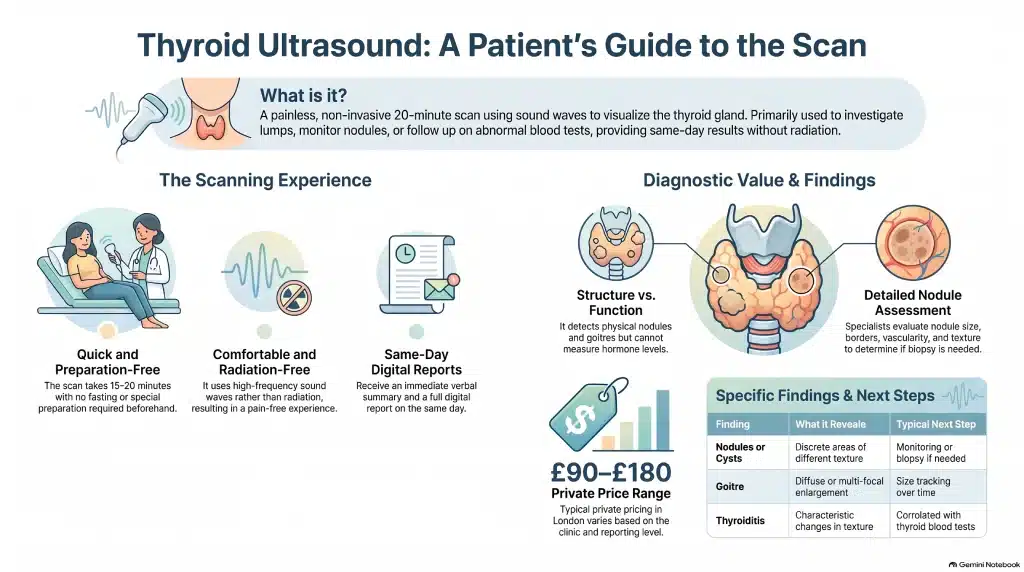
A thyroid ultrasound is a painless 15–20 minute scan that uses sound waves to check the size, structure, and any nodules in your thyroid gland — with a same-day digital report available privately in London.
Hear the summary of the text below from the following voice:
| Your question | Quick answer |
|---|---|
| How long does it take? | 15–20 minutes, no fasting or preparation needed |
| What can it find? | Nodules, goitre, thyroiditis patterns, and lymph node changes |
| What can’t it find? | Thyroid hormone levels — that needs a blood test |
| Who performs it? | Sonographers (HCPC-registered as radiographers) or consultant radiologists |
| Typical private price in London | £90–£180, depending on clinic and reporting level |
| How soon can I get results? | Verbal summary immediately; digital report usually the same day |
Definition
A thyroid ultrasound is a non-invasive examination of the thyroid gland and the surrounding structures in the neck. It uses high-frequency sound waves — the same principle behind sonar — to build a real-time picture of the gland’s size, shape, and internal texture, and to pick up any nodules or enlarged lymph nodes nearby. No radiation is involved, and the images are generated entirely from the echoes bouncing back through a handheld probe.
When and Why We Use Thyroid Ultrasound
Thyroid and Neck Ultrasound Scan is usually requested for one of a handful of reasons:
- Investigating a lump, swelling, or mass noticed in the neck.
- Following up on abnormal thyroid blood tests (TSH, T3, T4).
- Assessing a suspected thyroid nodule or goitre.
- Monitoring a previously detected nodule or cyst for change over time.
- Following patients with thyroiditis or autoimmune thyroid disease.
- Checking nearby lymph nodes when thyroid cancer is suspected or being monitored.
Most scans arrive through a referral from a GP, endocrinologist, or ENT specialist, though the appointment itself is arranged directly with the clinic.
What the Scan Includes
The sonographer images both thyroid lobes and the isthmus that connects them, then examines any nodules in detail against several characteristics that together indicate how likely a finding is to be benign.
| What’s assessed | Why it matters |
|---|---|
| Size | Tracks growth of a nodule or gland between scans |
| Borders | Well-defined edges are more reassuring than irregular ones |
| Vascularity | Doppler shows blood flow patterns within a nodule |
| Echogenicity | How the tissue reflects sound — a key marker of nodule type |
| Nearby lymph nodes | Checked for enlargement or suspicious features |
The whole appointment takes 15 to 20 minutes, and there’s no fasting or special preparation beforehand.
What to Expect on the Day
| Step | What happens |
|---|---|
| Arrival | A brief clinical history is taken |
| Positioning | You lie on the examination couch with your neck slightly extended |
| Scanning | Gel is applied to the neck and the probe is moved gently over the area |
| Summary | An immediate verbal summary is given, with a digital report usually the same day |
The procedure itself is comfortable and pain-free — most patients describe it as no more than a mild pressure from the probe.
Who Performs the Scan & Equipment Used
Scans are performed by sonographers — most holding HCPC registration in their base profession as diagnostic radiographers, since “sonographer” itself isn’t yet a protected title in the UK — or by consultant radiologists, using high-resolution ultrasound machines with Doppler capability so that any vascular changes within a nodule can be assessed alongside its structure.
Conditions Detected / Diagnostic Value
| Finding | What it looks like on ultrasound | Typical next step |
|---|---|---|
| Thyroid nodules or cysts | Discrete areas of different texture within the gland | Characterised by size, border and echogenicity; monitored or biopsied depending on features |
| Goitre / multinodular changes | Diffuse or multi-focal enlargement of the gland | Size tracked over time |
| Thyroiditis (e.g. Hashimoto’s) | Characteristic changes in gland texture | Correlated with blood test results |
| Suspicious nodule features | Irregular borders, certain echogenicity or vascular patterns | Fine needle aspiration on a separate appointment |
| Lymph node changes | Enlarged or abnormally shaped nodes near the thyroid | Assessed for metastasis in known thyroid cancer cases |
Lymph node checks on this scan are limited to the cervical nodes in the neck immediately around the thyroid — it’s not a whole-body lymphatic survey.
Safety and Limitations
Thyroid ultrasound uses no ionising radiation, so it’s considered safe to repeat as often as clinically needed, at any age. According to RadiologyInfo.org (Radiological Society of North America and American College of Radiology):
“Standard diagnostic ultrasound has no known harmful effects on humans.”
There are limitations to bear in mind. Very small nodules, or ones lying deep in certain neck anatomies, can be harder to visualise clearly. And ultrasound shows structure, not hormone output — it cannot tell you whether your thyroid is overactive, underactive, or normal. That determination still needs a blood test.
Pricing & Booking
Typical private pricing for a thyroid ultrasound in London runs from £90 to £180, depending on the clinic and the level of reporting included. Same-day or next-day appointments are often available, and booking can be done online or by telephone.
Locations
Phoenix Ultrasound scans are available at our Central London clinic in Holborn and at our Banstead, Surrey location.
Our Clinicians & Specialist Team
Scans are carried out by experienced consultant radiologists and sonographers with NHS endocrine imaging expertise, so nodule characterisation and lymph node assessment are read against the same standards used in hospital thyroid clinics.
Patient Experience
Patients consistently highlight fast appointment availability, minimal waiting times, and clear communication throughout the visit. Same-day digital reports mean results are ready in time for a GP or specialist follow-up appointment, without the usual wait.
References & Governance
All scans are carried out under full CQC registration, with clinical processes aligned to UK imaging standards and structured medical governance.
Leave a Reply