A private anomaly scan is a detailed mid-pregnancy ultrasound, usually booked from around 18 weeks, that checks your baby’s brain, spine, heart, limbs and organs, alongside your placenta and amniotic fluid.
Hear the summary of the text below from the following voice:
| What you want to know | The answer | Quick rule |
|---|---|---|
| When to book | 18-21+6 weeks (NHS standard); up to ~24 weeks for private/rescan appointments | Book as soon as your dating scan confirms gestation |
| What’s checked | Brain, spine, heart, limbs, face, kidneys, abdomen, placenta, fluid | A full head-to-toe anatomical survey |
| Typical London price | Around £200-£300+ | Varies by clinic, session length and extras |
| Appointment length | 20-40 minutes | Longer if baby is in an awkward position |
| GP referral needed? | No | Self-refer and book directly |
| Replaces NHS care? | No | It complements, not replaces, your NHS antenatal care |
Definition
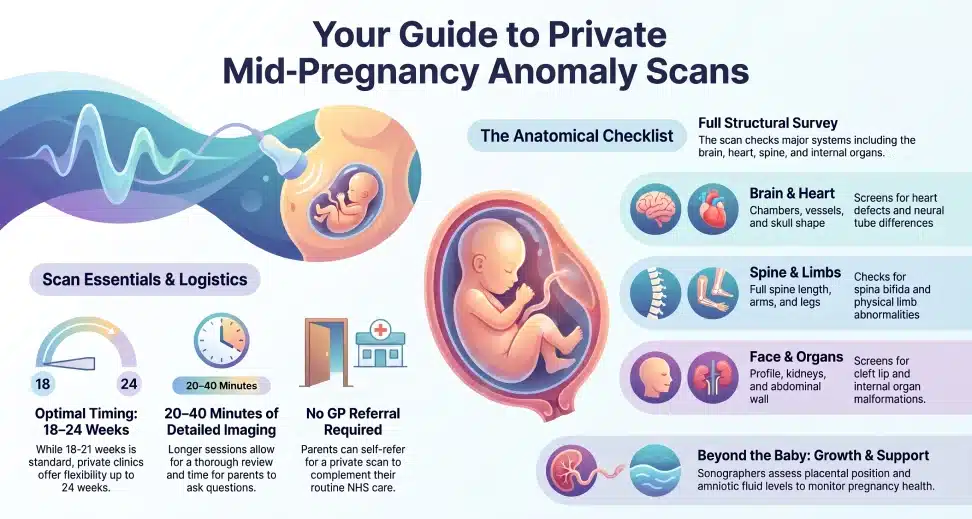
The anomaly scan is a detailed anatomical ultrasound carried out around the middle of pregnancy — usually 18-21+6 weeks as standard, with private appointments sometimes available up to around 24 weeks. Unlike an earlier dating or viability scan, it goes structure by structure through your baby’s organs, limbs, spine and brain, looking for signs that development is on track. The sonographer also assesses your placenta’s position and the volume of amniotic fluid around your baby, both of which affect how the rest of your pregnancy is monitored.
When and Why We Use Anomaly Scan
The NHS national 20-week screening scan is booked at 18-21+6 weeks; private clinics usually work within that same window, with some later slots available for a rescan or second look. Reasons to have a scan include:
- Routine screening of your baby’s structural development.
- Following up on a concern flagged at an earlier scan.
- Extra monitoring in a higher-risk pregnancy.
- Simple reassurance for parents alongside standard care.
It can pick up structural differences such as heart defects, neural tube defects and organ malformations, and it checks placental position and fluid levels. Many parents book a private scan to get a faster appointment, a longer session with more detail, or a second opinion alongside their NHS 20-week scan.
What the Scan Includes
A full anomaly scan works through every major system in a single appointment, from the standard 18-21+6 week window up to around 24 weeks for private or rescan bookings.
| Area examined | What we check | Why it matters |
|---|---|---|
| Head & brain | Skull shape, brain structures, spinal cord | Rules out neural tube and structural brain differences |
| Heart | Chambers, valves, major vessels | Congenital heart defects are among the most commonly screened conditions |
| Spine & limbs | Full spine length, arms, legs, hands, feet | Checks for open spina bifida and limb abnormalities |
| Face & abdomen | Facial profile, kidneys, bladder, stomach, abdominal wall | Screens for cleft lip/palate and abdominal wall or kidney conditions |
| Placenta & cord | Position, insertion, cord vessels | Flags a low-lying placenta early so it can be rechecked later |
| Amniotic fluid | Volume around your baby | Too much or too little fluid can indicate other issues to monitor |
Appointments generally run 20-40 minutes in a private clinic setting. Preparation is minimal — some clinics ask for a full bladder to improve visibility early in the window, while others need none at all, so it’s worth checking when you book.
What to Expect on the Day
You’ll arrive, register, and go through a brief health history and gestation check before the scan itself. You’ll lie on an examination couch while gel is applied and the sonographer moves an abdominal transducer over your tummy. Occasionally — for example if your baby’s position or a low placenta makes the view difficult — a transvaginal probe gives a clearer picture instead.
Throughout the appointment, the sonographer or consultant talks you through what they’re seeing and welcomes questions. At the end, you’ll get a verbal summary of the findings and next steps, with a written report and digital images usually sent the same day. If your baby’s position blocks a clear view of any structure, you’ll be offered a rescan rather than an incomplete result.
Who Performs the Scan & Equipment Used
Anomaly scans are carried out by HCPC-registered sonographers and radiographers, often working alongside GMC-registered consultant obstetricians and fetal medicine specialists, using high-resolution ultrasound machines with 2D, 3D and 4D capability and probes designed for detailed anatomical work. Clinics follow professional scanning protocols and quality-assurance standards so results are consistent and clinically reliable.
Conditions Detected / Diagnostic Value
The scan is designed to pick up major structural differences, plus general growth, placental position and fluid volume.
| Category | Examples | Detectability note |
|---|---|---|
| Brain & spine | Neural tube defects, open spina bifida | Usually well seen from 18 weeks onward |
| Heart | Congenital cardiac abnormalities | Detection rates vary with fetal position and heart complexity |
| Abdominal wall & kidneys | Exomphalos, gastroschisis, kidney/bladder abnormalities | Generally clear once the abdomen is well positioned |
| Face & limbs | Cleft lip (with or without cleft palate), limb differences | Cleft lip is usually well seen; an isolated cleft palate (no lip involvement) is much harder to detect on ultrasound |
| Chromosomal-linked | Structural markers linked to Edwards’ and Patau’s syndromes | Ultrasound flags markers; diagnosis needs separate genetic testing |
Pregnancy Scans are screening tools rather than guarantees — some conditions are only visible later in pregnancy or not on ultrasound at all. According to the NHS:
“an ultrasound scan to look for 11 different conditions in your baby”
— alongside checking growth, so a “clear” result is reassuring but not an absolute guarantee.
Safety and Limitations
Ultrasound is radiation-free, non-invasive and widely used throughout pregnancy, with no known risk to you or your baby. That said, several factors can limit how much the sonographer can see on the day.
| Factor | How it can limit the scan |
|---|---|
| Baby’s position | Curled up or facing inward, some views may be partly obscured |
| Maternal BMI | Higher BMI can reduce image clarity through the abdominal wall |
| Gestational age | Too early or too late in the window affects how well structures show |
| Placental position | An anterior placenta can partly shadow the view behind it |
The scan does not replace diagnostic tests such as amniocentesis or specialist fetal MRI where these are indicated, and a private scan should complement — never replace — your standard NHS antenatal care.
Pricing & Booking
Prices vary by clinic, session length and any extras such as additional views or a specialist review.
| Scenario | Typical London range* | What’s usually included |
|---|---|---|
| Standard anomaly scan | ~£200-£260 | Full anatomical survey, verbal summary, digital images |
| Extended or specialist review | ~£260-£300+ | Longer session, additional views, consultant input |
| Rescan (if needed) | Often reduced or included | Repeat look at any area not clearly seen first time |
*General London market range — confirm the current price with the clinic before booking, including whether digital images, a written report, or a rescan are included or charged separately.
Booking is usually self-referred, online or by phone, with no GP referral required — many clinics offer same-day or next-day appointments.
Locations
Coverage spans Central London and surrounding areas, with many clinics offering convenient access plus evening and weekend appointments for parents balancing work and other commitments.
Our Clinicians & Specialist Team
Scans are carried out by an experienced team of sonographers, fetal medicine specialists and obstetric radiologists with both NHS and private-sector backgrounds. Sonographers and radiographers hold HCPC registration, while consultant doctors are registered with the GMC — all with a shared focus on clear communication and attentive, unhurried care throughout your appointment.
Patient Experience
Expect a comfortable, private setting with minimal waiting time — partners and support people are welcome, and some clinics display a large screen so you can view the images together. You’ll get prompt feedback, digital image access and clear next steps, with the emphasis on reassurance and a thorough explanation of what was found. If the scan does raise a concern, a private clinic will not simply hand you a report and leave you to it — you should be referred directly into your local NHS Fetal Medicine Unit for further assessment and support, alongside your existing midwife or obstetric team.
References & Governance
Private ultrasound services are regulated by the Care Quality Commission (CQC) or the equivalent body, and scans should be performed by qualified professionals against recognised clinical standards. Any clinic you choose should be clear that this scan complements, rather than replaces, your routine NHS antenatal care and screening.
Leave a Reply