Carotid Doppler Scan: Carotid Artery Ultrasound Test & Price
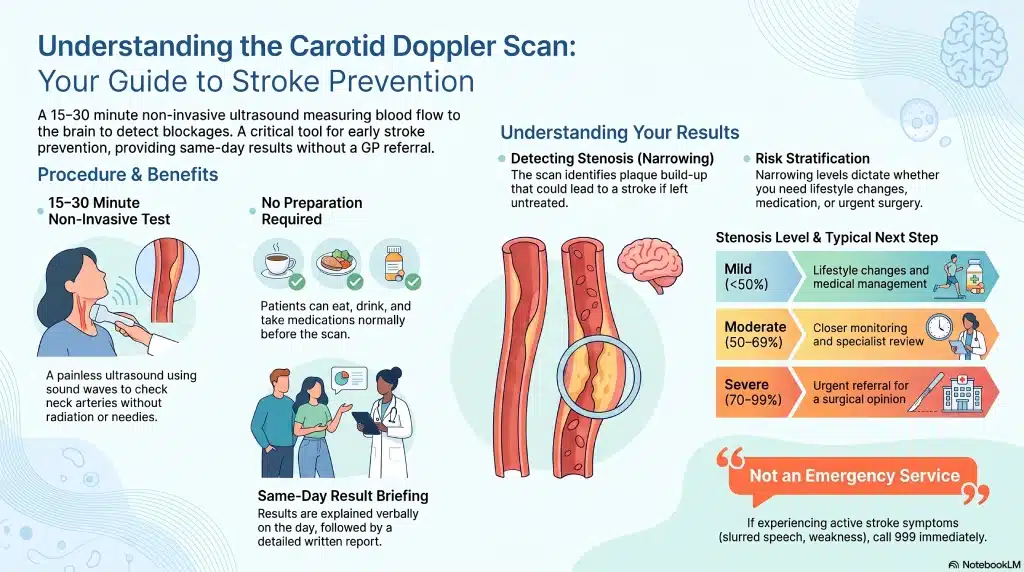
A carotid Doppler scan is a painless ultrasound test that checks blood flow in the arteries in your neck, takes 15–30 minutes with no referral needed, and costs from £245 privately with results explained the same day.
| Question | Quick Answer |
|---|---|
| What is it? | An ultrasound + Doppler scan of the carotid arteries that supply blood to the brain |
| How long does it take? | 15–30 minutes for both sides of the neck |
| How much does it cost? | From £245 for a bilateral scan — full pricing details available below |
| Is any preparation needed? | No preparation required — no fasting or medication changes are needed |
| When are the results available? | Results are explained verbally on the day, with a written report provided shortly afterwards |
| Who typically needs one? | People with stroke/TIA symptoms, vascular risk factors, or those requiring pre-surgical screening |
Important: This scan is for planned risk-factor screening and monitoring — it is not an emergency service. If you currently have symptoms of a stroke or TIA (sudden facial drooping, arm or leg weakness, slurred speech, or sudden vision loss), call 999 or go to A&E immediately. Do not wait to book a private scan.
Listen to the Audio Summary
Definition
A carotid Doppler scan — also called a carotid duplex scan, carotid ultrasound, or Doppler flow study — uses sound waves to measure how fast blood moves through your carotid arteries and in which direction. “Doppler” refers specifically to the flow-measuring technique; combined with standard ultrasound imaging of the vessel wall, it forms a “duplex” scan. Its purpose is to detect narrowing (stenosis) or blockages in the neck arteries that feed the brain, catching problems early enough to help prevent a stroke.
When and Why We Use Carotid Doppler
Clinical Indications & Risk Factors
Your doctor — or you, self-referring privately — might request this scan if you have any of the following:
A previous stroke or transient ischaemic attack (TIA)
A carotid bruit picked up on examination
Hypertension, high cholesterol, or diabetes
A smoking history or family history of vascular disease
Planned cardiac or carotid surgery requiring pre-operative screening
General high-risk screening even without symptoms
NHS vs Private Access & Urgency
People with a suspected TIA should reach specialist assessment fast. According to NICE:
“…to be seen within 24 hours of onset of symptoms”
That’s the current guideline timeframe for suspected TIA cases — not 48 hours, as sometimes assumed. NHS waiting times for non-urgent carotid imaging can still run to six weeks or more, whereas a private scan can often be booked within days.
Benefits & Alternatives
| Method | Radiation | Invasiveness | Best For |
|---|---|---|---|
| Carotid Doppler Ultrasound | None | Non-invasive | First-line screening and ongoing monitoring |
| CT Angiography (CTA) | Low-dose radiation | Contrast injection | Detailed plaque assessment and vessel mapping |
| MR Angiography (MRA) | None | Contrast used in some protocols | Follow-up when ultrasound results are inconclusive |
| Digital Subtraction Angiography (DSA) | Yes | Invasive (catheter-based procedure) | Pre-surgical planning in complex cases |
What It Can & Cannot Detect
This scan reliably detects This scan may miss
Plaque build-up and calcification Very small or distal lesions further along the vessel
The degree of stenosis (narrowing) Detail obscured by a short neck, obesity, or patient movement
Complete occlusion (blockage) Lesions better characterised on cross-sectional imaging
Carotid intima-media thickness (CIMT) —
It works as both a diagnostic tool and a surveillance tool, so the same scan that catches a problem today can also track it over time.
Risk Stratification & Next Steps
Your result feeds directly into what happens next: normal flow usually means no action beyond routine monitoring, mild-to-moderate narrowing is usually managed with medication and lifestyle changes, and significant stenosis triggers referral to a vascular surgeon or neurologist for a surgical opinion.
What Your Scan Includes
After a quick registration and explanation, you’ll lie on the couch while the sonographer scans both sides of your neck with a high-frequency probe — covering the common, internal, external, and vertebral arteries. It takes 15–30 minutes. You get verbal feedback immediately, followed by a written report with velocity charts and images; a CIMT measurement can be added on request.
Preparation Before the Scan
No special preparation is required — no fasting and no medication adjustments. You can go straight back to your normal day afterwards.
What to Expect on the Day
Wear loose clothing with an open collar and remove any neck jewellery. You’ll lie on the couch with your head turned slightly to one side while the sonographer applies cool gel and moves the probe over your neck — you’ll feel mild pressure but nothing more. It’s entirely comfortable, and the sonographer talks you through the findings before the formal report is issued.
Who Performs the Scan & Equipment Used
Scans are carried out by experienced vascular sonographers using colour and spectral Doppler systems with high-frequency linear probes, kept to regular quality-control and calibration standards.
Safety, Limitations & Contraindications
Carotid Doppler is non-ionising, painless, and carries no known side effects. Practical limitations include obesity, neck wounds, heavy calcification, or movement during the scan; an inconclusive result may prompt a follow-up CTA or MRA. True contraindications are rare — mainly an open wound or very recent neck surgery.
Pricing & Booking
Scan Price Notes
Carotid Artery & CIMT Scan (bilateral) £245 Both carotid arteries, CIMT measurement included
Full Vascular Doppler Scan Package £680 Carotid + abdominal aorta + arterial Doppler in one visit
Combined with Echocardiography from £465 Heart and carotid assessment in a single appointment
Booking Carotid Artery Doppler & CIMT Scan is available online, by phone, or by email, with same- or next-day appointments in most cases — no GP referral needed, with flexible payment options.
Interpretation of Results & Next Steps
Result What it means Typical next step
No significant stenosis Normal flow velocity; may still show minor, non-flow-limiting plaque Routine monitoring; lifestyle advice if plaque is noted
Mild stenosis (<50%) Early narrowing Lifestyle changes, medical management
Moderate stenosis (50–69%) Significant narrowing Closer monitoring, specialist review
Severe stenosis (70–99%) Critical narrowing Urgent referral, possible surgery
Complete occlusion Artery fully blocked Specialist neurovascular assessment
A “no significant stenosis” result describes blood-flow velocity, not the total absence of plaque — the written report covers the vessel wall in full, and the sonographer will talk you through anything it shows. If you develop new or worsening symptoms — sudden weakness, slurred speech, or vision changes — treat this as a medical emergency and call 999 rather than waiting for a follow-up scan. It’s also worth sharing your written report with your GP so it sits alongside your wider medical record.
About Vascular Ultrasound (Context)
Carotid Doppler is one part of a wider vascular ultrasound family that assesses blood flow throughout the body. If you’re being screened in one area, it’s often worth checking others: a leg artery ultrasound (arterial Doppler) checks circulation in the legs and arms, a venous Doppler scan looks for clots or vein problems, and an aortic ultrasound scan screens the abdominal aorta for aneurysms.
Locations
Phoenix Ultrasound offers carotid Doppler scans at two clinics:
- Central London: 1 Portpool Lane, Holborn, London, EC1N 7UU
- Surrey: 63 Nork Way, Banstead, SM7 1HL
Call 020 3318 1373 or email contact@phoenix-ultrasound.co.uk to book at either location.
Patient Reviews & Experience
Phoenix Ultrasound holds a strong aggregate rating on Trustpilot, with recurring themes of comfort, professionalism, and clear explanations from the sonographer.
Evidence, Accreditation & Governance
Phoenix Ultrasound is registered with the Care Quality Commission (CQC), the independent regulator of health services in England, and follows current NHS and NICE guidance on stroke and vascular risk.
Why Choose Us / Differentiators
Same-day results, transparent pricing, and a consultant-led service set Phoenix Ultrasound apart, alongside flexible scheduling and the option to combine your carotid scan with other cardiovascular assessments in one visit.
Leave a Reply